Hallway Runner: How to Find the Right Size
The hallway is the narrowest room in the apartment, and yet it is where most runner mistakes happen. It slips the moment you walk through quickly. It drags against the door. Or it lies there looking lost because it is two sizes too small. Almost always, this comes down to the wrong size. Once you know the right measurements, you can order without lengthy deliberation.
Everything Is Decided at the Door Swing
Before you think about length, take a look at the doors. Doors must be able to open freely at both ends of the runner. The front door should move without any problem, without dragging over the rug. That is exactly where the length starts.
Picture a typical apartment hallway: front door at one end, bathroom door on the side. So that both doors can swing freely, you subtract at least the width of the door panel from the runner length. That is the simplest rule to avoid the most common placement mistake, namely a runner that blocks the doors.
How Long the Runner Should Be
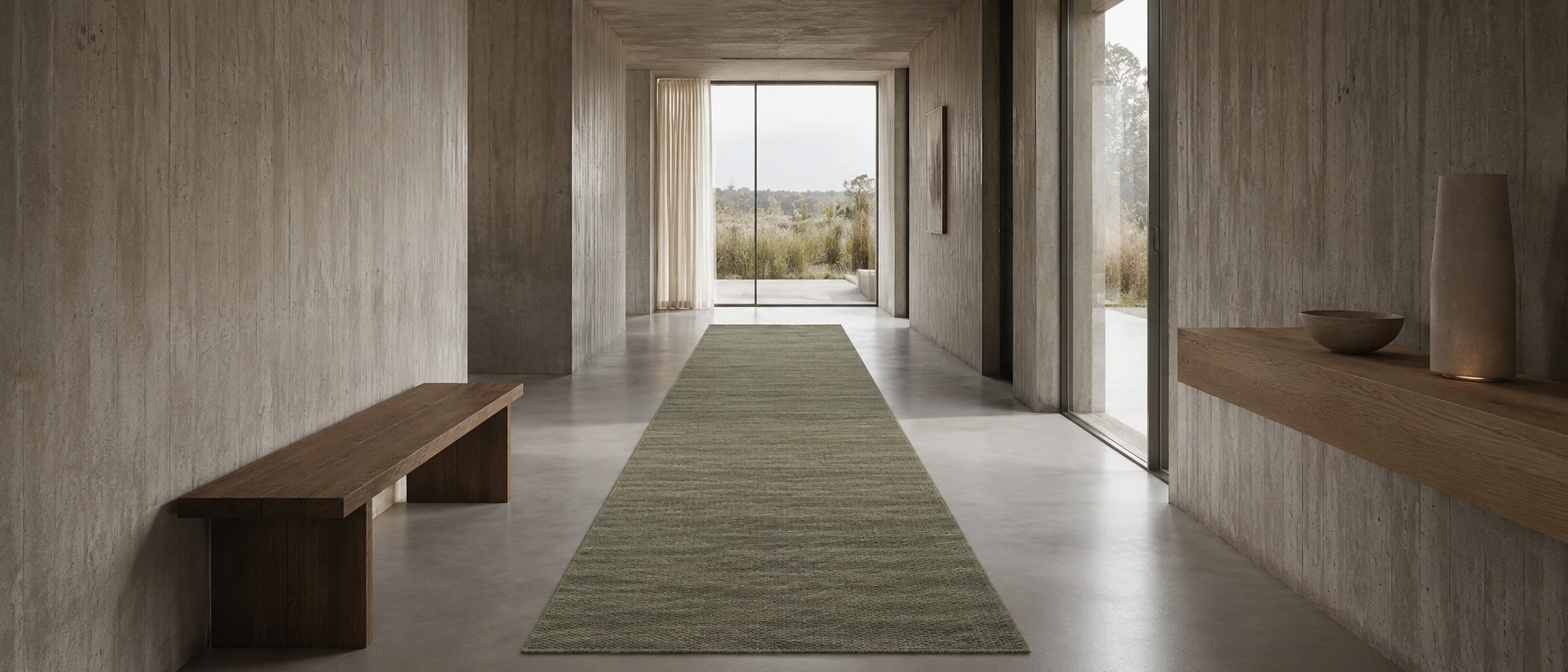
The rule of thumb is short: measure the hallway length, subtract around 30 cm, done. In most apartment hallways, this results in a length between 200 and 300 cm. This way, floor remains visible at both ends and the rug runner looks deliberately placed.
For those who prefer more precision: the optimal length is usually 80 to 90 percent of the total hallway length. Another guideline suggests 30 to 120 cm of exposed floor at both ends combined. Common standard lengths are 200, 250, and 300 cm; for very long hallways, 350 cm or more as a single continuous piece.
That single piece is important. Two shorter runners placed end to end rarely look convincing and usually come across as a makeshift solution. If your hallway is very short, meaning under 2 meters, a square doormat can be the smarter choice than a long runner. In rather small hallways, lengths between 100 and 120 cm are also popular.
In a Narrow Hallway, the Slimmer Format Wins
For width, the rule is: 10 to 20 cm of floor should remain visible on each side. This border is what makes the hallway look structured. As a guideline, around 10 to 15 cm on each side is sufficient.
In a narrow hallway, this means: choose narrower. An example from an older building, 90 cm wide. Instead of the classic 80 cm, you go for 60 to 65 cm, so that 10 to 15 cm of floor remain visible on each side. In hallways under 100 cm wide, 50 to 60 cm is often the better option. As a general rule for narrow hallways: no wider than 60 to 70 cm. Another guideline: the runner takes up roughly one third to one half of the hallway width.
| Hallway Width | Recommended Runner Width |
| under 100 cm | 50 to 60 cm |
| 120 to 150 cm | 70 to 80 cm |
| over 150 cm (entryway) | 90 to 100 cm |
The Entryway Can Handle More
A wide entrance hall over 150 cm can take considerably more. Here you can go for widths from 100 cm upward, and the space still feels airy. For medium widths of 100 to 150 cm, runners of 80 to 100 cm work well. This gives the entryway a clear central axis without the floor disappearing entirely.
Here, too, the side border remains the key reference point. 15 to 20 cm per side is appropriate. Placement remains important: the runner belongs in the center, approximately 10 to 15 cm from the walls. If you place it directly against one wall, the entryway immediately looks narrower and more cramped.
A Runner Stays Non-Slip Only with the Right Underlay
In the hallway, people rarely walk slowly. You come in, throw off your jacket, hurry on. At that pace, a loose runner shifts quickly, and then it becomes a tripping hazard. An anti-slip underlay keeps it in place and makes it safe.
Precisely because the hallway is the most heavily trafficked strip of the apartment, the underlay is especially worthwhile. It also ensures that the edges stay flat and the door swings cleanly over it.
Flat and Durable: Low Pile in the Hallway
When it comes to material, durability counts. Polypropylene is considered the most hard-wearing choice for heavily used hallways: moisture-resistant, dirt-repellent, and cleanable with a damp cloth. The trade-off: it feels less soft and looks less refined. Polyamide is also hard-wearing and easy to care for. Cotton is softer and usually machine-washable, good for moderate use or households with small children. Jute and wool, on the other hand, do not belong in the washing machine, and delicate materials such as silk have no place in the hallway.
And the pile height? Low pile is the smarter choice in the hallway. A pile height under 10 mm makes the runner look optically wider, which helps in a narrow space. From around 10 to 12 mm pile height, door clearance becomes tight. A thick high-pile rug risks causing doors to drag or jam. Flat and durable: that is the combination that works best in the hallway.
FAQ
How long should a hallway runner be?
Measure the total hallway length and subtract around 30 cm. In most apartment hallways, this results in a length between 200 and 300 cm. This way, floor remains visible at both ends and the runner looks deliberately placed rather than randomly laid.
What do I need to consider at the door swing?
Subtract at least the width of the door panel from the runner length. Doors must be able to open freely at both ends, and the front door should move without dragging over the rug. A runner that blocks doors is the most common placement mistake.
How wide can a runner be in a narrow hallway?
In narrow hallways, no wider than 60 to 70 cm. For a width under 100 cm, 50 to 60 cm is often better. This keeps 10 to 20 cm of floor visible on each side, making the hallway look structured and airy.
Why do I need an anti-slip underlay in the hallway?
Because the hallway is the most heavily trafficked strip of the apartment and a loose runner shifts at a fast pace. An anti-slip underlay keeps it in place, prevents tripping hazards, and keeps the edges flat so the door swings cleanly over it.
What pile height is suitable in the hallway?
Low pile under 10 mm. A low pile height makes the runner look optically wider and does not interfere with the door swing. From around 10 to 12 mm pile height, door clearance becomes tight, and a thick high-pile rug risks causing doors to drag or jam.