Choosing the Right Rug Size: Living Room, Dining Room, Bedroom, Hallway
Why Size Matters More Than Colour or Pattern
Many people spend a great deal of time searching for the right pattern or the perfect colour. Yet rug size is the only criterion that determines success or failure before the rug is even unrolled. A rug that is too small looks accidental, leaves furniture disconnected in the room and robs the space of its calm. A well-chosen rug, on the other hand, holds a seating group together, anchors a dining table and creates that pleasant feeling in the bedroom of stepping onto something soft first thing in the morning.
This guide helps you make that decision with confidence. Not through rigid rules, but through a clear logic: What should the rug achieve? Which pieces of furniture should it bring together? What overhang looks harmonious? Answering these questions leads to the right size far faster than hours of comparing standard dimensions.
Rug Size in the Living Room: The Seating Group as the Reference Point
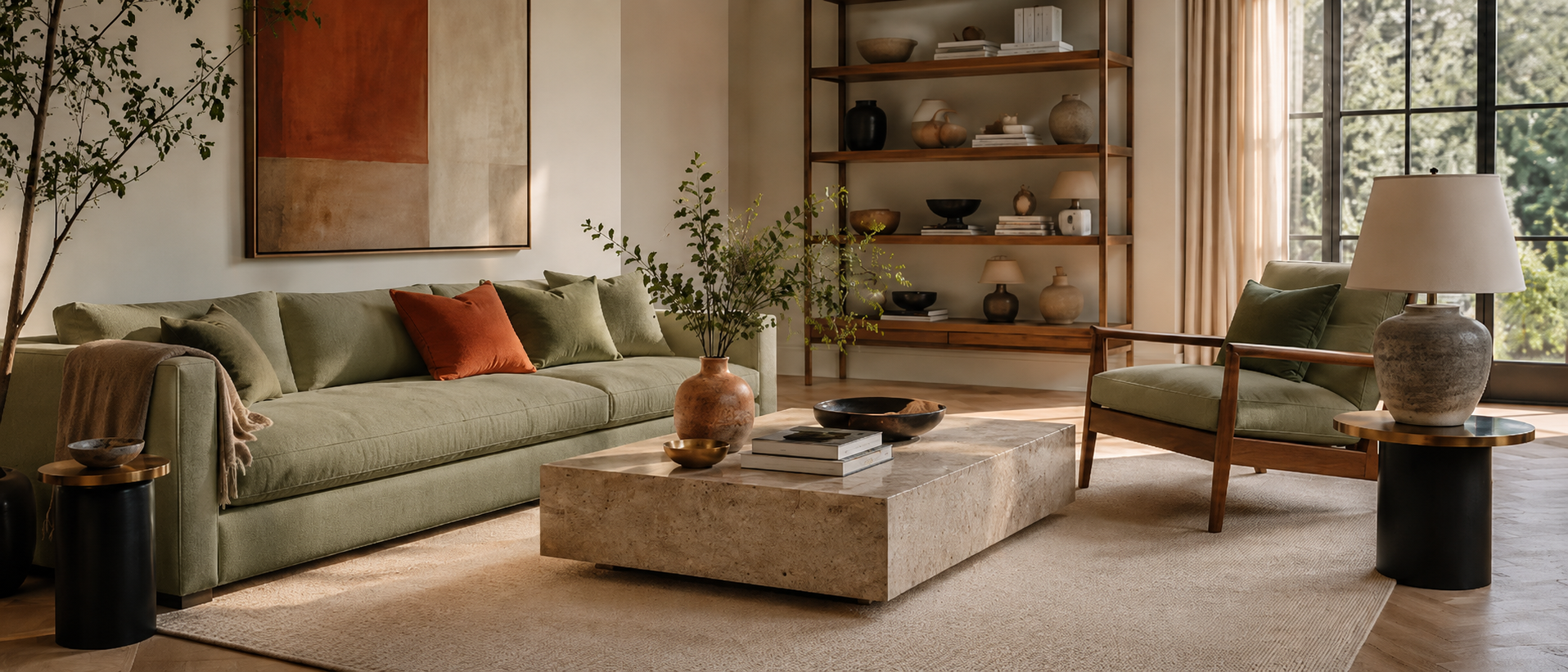
In the living room, the rug is not a decorative element sitting randomly under the coffee table. It is the unifying element of the entire seating group. Sofa, armchairs and coffee table should visually belong together, and the rug is what creates that connection.
The most important rule of thumb: the rug should be wider than the sofa, and at least the front legs of the sofa and armchairs should rest on it. If only the coffee table is placed on the rug, a size that is too small has almost certainly been chosen. The sofa then appears detached and the room feels less settled.
As a general guide:
- 160 × 230 cm suits smaller living rooms with a compact two-seater sofa.
- 200 × 300 cm is the most harmonious choice for many classic living areas.
- 250 × 350 cm or larger is worthwhile for large sofas, corner sofas or open-plan living spaces.
When in doubt, go one size up. A rug that supports the entire seating group never looks too large. A rug that only captures part of it almost always looks too small.
Particular attention should be paid to the rug's edge: it should not end precisely where furniture legs stand. Either the furniture stands clearly on the rug, or clearly off it. An edge that bisects furniture legs looks restless and accidental.
Rug Size in the Dining Room: The Chair Sets the Measure
In the dining room, many people think first of the table. The actual reference point, however, is the chair, specifically the pulled-back chair. When someone sits down and pushes back from the table, they move approximately 60 to 75 centimetres backwards. This movement space must lie entirely on the rug, otherwise chair legs catch on the edge or tip over the border when standing up.
This leads to a simple calculation: the rug area should be at least 60 to 75 cm larger than the tabletop on every side. For a table measuring 90 × 180 cm, that means a rug size of at least 210 × 330 cm. For a table of 100 × 200 cm, it is correspondingly 220 × 350 cm or similar.
A few further points that are particularly relevant for the dining room:
- With 6 to 8 chairs, significantly more surface area is needed than with 4 chairs.
- Under round tables, round rugs look especially harmonious, provided they are chosen large enough. A round rug that is too small under a round table makes the problem even more pronounced.
- Low-pile or flatweave rugs are more practical in the dining room than high-pile. They are easier to clean, chair legs glide more evenly and the edges remain more stable.
A rug that is too small in the dining room is not merely a visual issue. It is an everyday inconvenience that is noticeable every time someone stands up.
Rug Size in the Bedroom: Softness and Symmetry
The bedroom follows a different logic to the living room or dining room. Here it is about atmosphere, comfort and the feeling of that first step out of bed. The rug should create calm, and calm comes from symmetry and sufficient overhang.
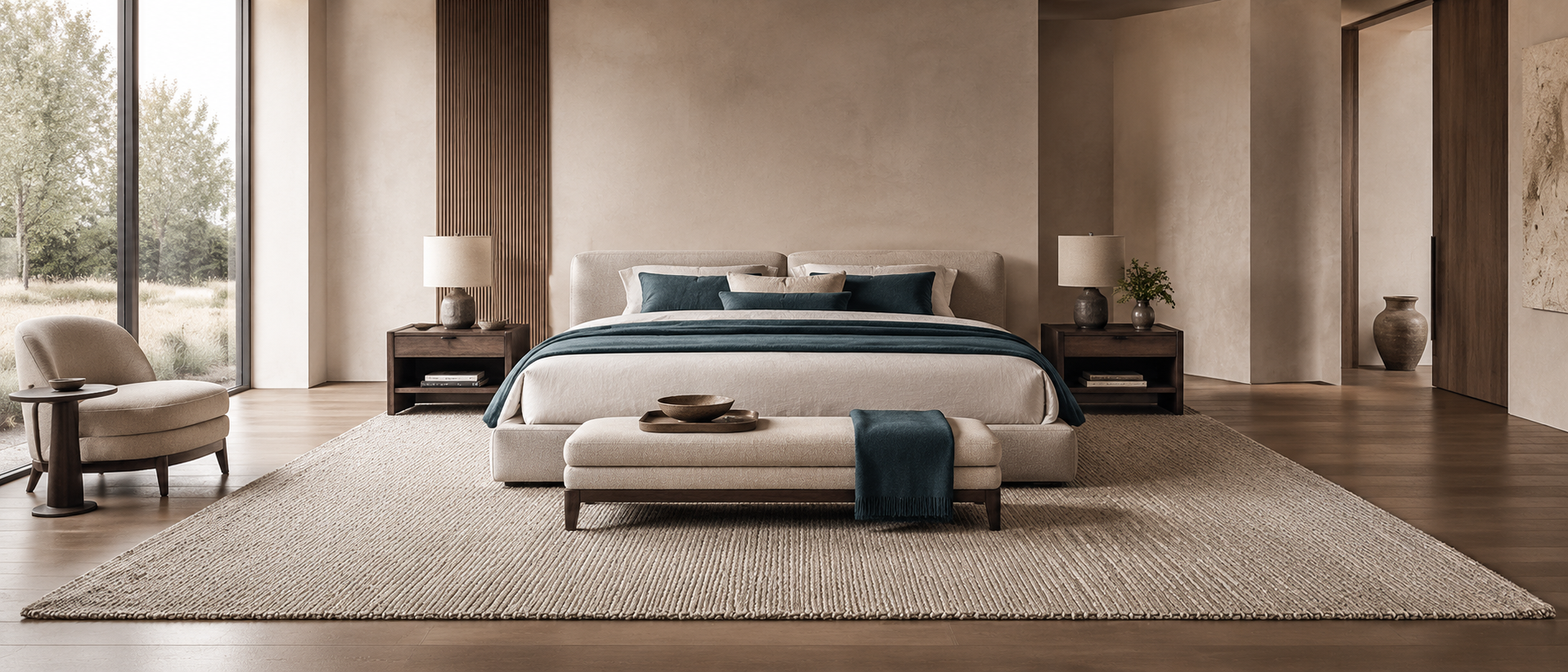
The classic approach: a large rug is slid under the bed and extends visibly on the sides and at the foot end. A comfortable guideline is around 45 to 60 cm of overhang on each side. That way, feet land softly when getting up and the rug is present in the room even with the bed on top of it.
For a standard double bed of 160 × 200 cm, sizes such as 200 × 300 cm or 250 × 350 cm are often suitable. For larger beds or generous bedrooms, the overhang may be correspondingly greater.
Those who prefer not to place a large rug under the bed can alternatively choose two runners: one on each side. This solution is particularly practical when the bed is heavy or when the floor covering beneath it needs to be maintained. It is important that the runners are long enough for feet to land fully when getting up.
Material and texture play a particularly important role in the bedroom. A soft wool rug or a rug with a pleasant surface makes the morning moment noticeably more enjoyable.
Hallway Runners: Guide, Protect, Proportion
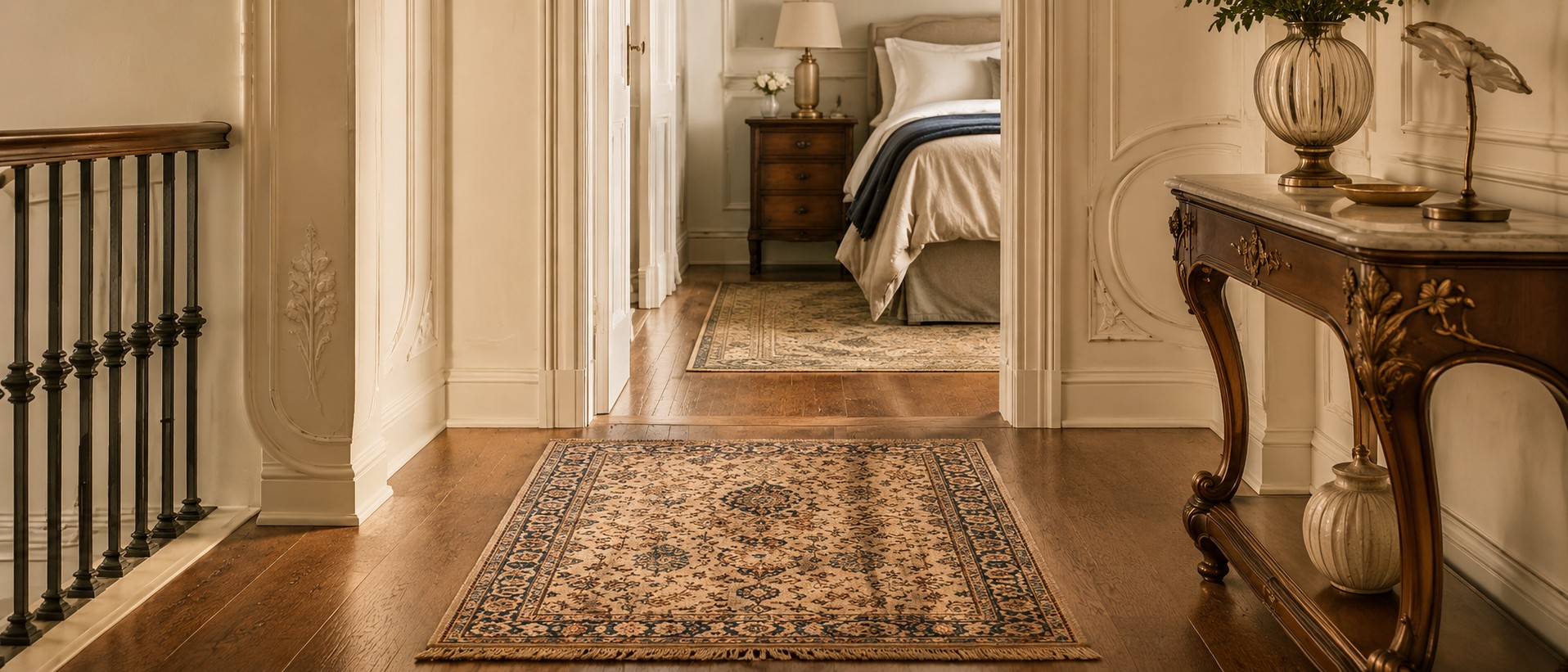
The hallway presents particular requirements: the rug must be functional, robust, non-slip and proportional to the space. A runner that looks like a narrow strip misses its purpose. It should visually structure and guide the corridor without dominating it.
Reliable guidelines for the hallway:
- Around 10 to 15 cm of floor should remain visible on both sides.
- The length of the runner should emphasise the hallway, reaching as close as possible to the walls or door frames.
- Doors must be able to open freely. Choosing a thick high-pile runner risks doors dragging or jamming on it.
- For entrance areas and heavily used corridors, flat, robust rugs that are easy to clean are recommended.
- A non-slip underlay is particularly important in the hallway, as runners on smooth floors can shift with every step.
In the corridor, everyday practicality is the most important criterion. A beautiful runner that becomes worn or slips after a few months does not fulfil its purpose. The combination of the right width, stable quality and a non-slip underlay is the best investment here.
Measuring Correctly: Furniture Zone Rather Than Room Size
The most common mistake when measuring is to measure the entire room and then choose a rug size that fits proportionally to it. What matters, however, is the furniture zone: the area in which the relevant furniture stands and is used.
A proven approach in four steps:
- Position the furniture: Arrange the sofa, dining table, bed or other furniture as it will stand later.
- Mark the area: Tape out the desired rug area on the floor with painter's tape. This makes the effect visible before the rug is ordered.
- Check movement areas: In the dining room, pull chairs back and check that they remain within the marked area. In the bedroom, test where feet land in the morning. In the living room, check that the sofa and armchairs are visually connected with the coffee table.
- Choose a standard size: Only then determine the nearest available size. If the marked area falls between two sizes, it is worth choosing the larger one.
This step takes just a few minutes and prevents the most common purchasing mistake in the rug category.
The Most Common Mistakes and How to Avoid Them
A brief overview of the decisions that are most frequently regretted in hindsight:
- Rug chosen too small because only the coffee table served as the reference point.
- Dining room rug without sufficient overhang for pulled-back chairs.
- Bedroom rug that almost entirely disappears under the bed and has no visible effect.
- Hallway runner that blocks doors or is too narrow for the corridor.
- High-pile rug in heavily used areas that is difficult to clean and deteriorates quickly.
- Round rug under a round table chosen too small, making it appear even smaller.
- No non-slip underlay for runners on smooth parquet or tiles.
All of these mistakes can be avoided with the right preparation. Anyone who measures out the furniture zone with tape before ordering almost always makes the better decision.
Rules of Thumb at a Glance
For those looking for a quick orientation, here are the most important guidelines summarised:
- Living room: Rug wider than the sofa, front legs of all seating furniture on the rug. Common sizes: 160 × 230 cm, 200 × 300 cm, 250 × 350 cm.
- Dining room: At least 60 to 75 cm more than the tabletop on all sides, so that chairs remain on the rug when pulled back.
- Bedroom: 45 to 60 cm of visible overhang on the sides and at the foot end. Common sizes: 200 × 300 cm or 250 × 350 cm for double beds.
- Hallway and corridor: 10 to 15 cm of floor clearance on both sides, doors must be able to open freely, low pile for heavily used areas.
These values are reference points, not rigid specifications. What always matters is the specific furniture arrangement, the room size and the desired effect. Anyone who understands why certain sizes work will also make the right choice in special situations.
FAQ
Which rug size suits the living room?
The rug should hold the entire seating group together. As a guideline: at least the front legs of the sofa and armchairs should rest on the rug, and the rug should be wider than the sofa. For smaller living rooms, 160 × 230 cm works well; for many classic living areas, 200 × 300 cm is the more harmonious choice; and for large seating groups or corner sofas, 250 × 350 cm or more is recommended. When in doubt, it is worth going one size up.
How large does a rug under the dining table need to be?
The rug should be around 60 to 75 cm larger than the tabletop on every side. The key point is that chairs remain fully on the rug even when pulled back. If the rug is too small, chair legs tip over the edge. Low-pile or flatweave rugs are more practical in the dining room than high-pile: they are easier to maintain and chairs move more evenly on them.
What rug size do I need in the bedroom?
The rug should extend visibly beyond the bed area on the sides and at the foot end. A comfortable guideline is around 45 to 60 cm of overhang on each side. For a double bed, 200 × 300 cm or 250 × 350 cm are often suitable. An alternative is two runners on the left and right beside the bed, so that feet land softly when getting up.
How wide should a hallway runner be?
The runner should be chosen in proportion to the hallway. As a guideline, around 10 to 15 cm of visible floor on both sides is advisable, so that the corridor appears structured. Equally important: doors must be able to open freely. A flat rug is therefore recommended in the hallway, especially where doors swing over the floor. A non-slip underlay is strongly advisable on smooth surfaces.
What is the most common mistake with rug sizes?
The rug is chosen too small. This happens most frequently in the living room when only the coffee table serves as the reference point, and in the dining room when the chair overhang is not factored in. A rug that is too small leaves furniture looking disconnected and makes the room visually more restless. Anyone who marks out the furniture zone on the floor with painter's tape before ordering almost always makes the better decision.