Rug slides and bunches up: what really helps
Every morning you straighten the runner in the hallway, and every evening it has moved two hand-widths in front of the front door again. Sound familiar? A rug that wanders is more than a minor inconvenience. In a walkway, a raised edge becomes a tripping hazard that you can easily catch your foot on. And sliding is different from throwing up waves. Anyone who keeps the two apart will find the right solution more quickly.
When a wandering rug becomes a tripping hazard
As long as the mat sits under the dining table where few people pass by, a slightly shifted rug is mainly a question of tidiness. It becomes critical where people walk every day: in the entrance area, in front of the bathroom, on the path between kitchen and living room.
Think of a grandmother with a walker who steps over the same mat edge every single day. Or the moment you stumble out of bed half-asleep in the morning. A raised edge or a wave in the middle of a walkway then becomes a real tripping hazard. Household safety guides explicitly list the rug edge alongside loose cables, wet stairs and poor lighting as a typical cause of falls. The BFU recommends fitting a non-slip underlay beneath the rug in the entrance area. That is not scaremongering, but a good reason to solve the problem properly once rather than adjusting it every evening.
Why smooth floors in particular encourage sliding
The rule is simple: the smoother the floor, the more likely the rug is to wander. On parquet, laminate and tiles, the friction that would naturally be present on a carpet floor is missing.
Usually the smaller pieces are affected: runners, doormats, bathroom mats. The classic case is the mat on bathroom tiles that slides away when you step out of the shower. Larger rugs tend to shift gradually over time or throw up waves when they are lying in an unfavorable position.
It also matters what is standing on the rug and what its underside looks like:
- Loosely laid rugs with a woven backing slide particularly strongly.
- When furniture stands on the rug, it stays in place considerably better.
- Dirt on the underside or on the floor further reduces grip.
One tip upfront: before you take any measure, the rug and floor should be clean. Beat the rug out beforehand so that the deeper-lying dirt the vacuum cleaner cannot reach is loosened. Otherwise every underlay is working against a layer of dust.
Lying waves in new rugs: what is normal and how long it takes
A new rug that throws up waves usually has no quality problem. It was rolled or folded in its packaging for weeks, and the fibers as well as the backing need time to relax again. The backing retains the rolled shape, which is why edges lift and folds set in. These lying waves are normal and as a rule temporary.
How long this takes depends on the material:
- Thin, low-pile and washable rugs usually lie flat within one to two days.
- Thicker rugs or natural fiber models made from wool or jute may need a week or longer.
- As a rule of thumb: a few days up to around two weeks.
You can help it along. One effective method is to loosely roll the rug in the opposite direction for several hours up to overnight. This often causes the edge of a new wool rug to lower again after just one night. Alternatively, weigh down the wave with flat, light objects such as books. These can remain in place for up to 72 hours. Use only light weights, as heavy objects can damage the pile or fibers.
For heat-resistant materials, a damp cloth placed on the wave helps, over which you carefully pass steam without the iron or steam coming into direct contact with the rug. Test this method on an inconspicuous spot first. Important: if you are flattening the rug with books, let it rest for one to two days before fixing it in place.
Four ways to make a rug non-slip
Sliding and waves in a walkway are ultimately resolved by securing a firm position. Several options exist for this, differing in effort and material care.
| Solution | Suitable for | What to watch out for |
|---|---|---|
| Anti-slip underlay | Almost all rugs and floors, gentle on materials | Lay loosely underneath, cut approximately 2.5 to 5 cm smaller than the rug |
| Rug-stop spray | Smaller rugs for fixing the underside | Test beforehand on an inconspicuous spot and on the floor type |
| Rug tape | Firm, permanent fixing | Can leave adhesive residue; use with care on sensitive floors |
| Non-slip backing as standard | Rugs equipped for wood, tiles or laminate | Check the material specification when purchasing |
As a general rule: the less permanently you fix, the more gentle it is on both rug and floor.
The anti-slip underlay as the material-friendly standard solution
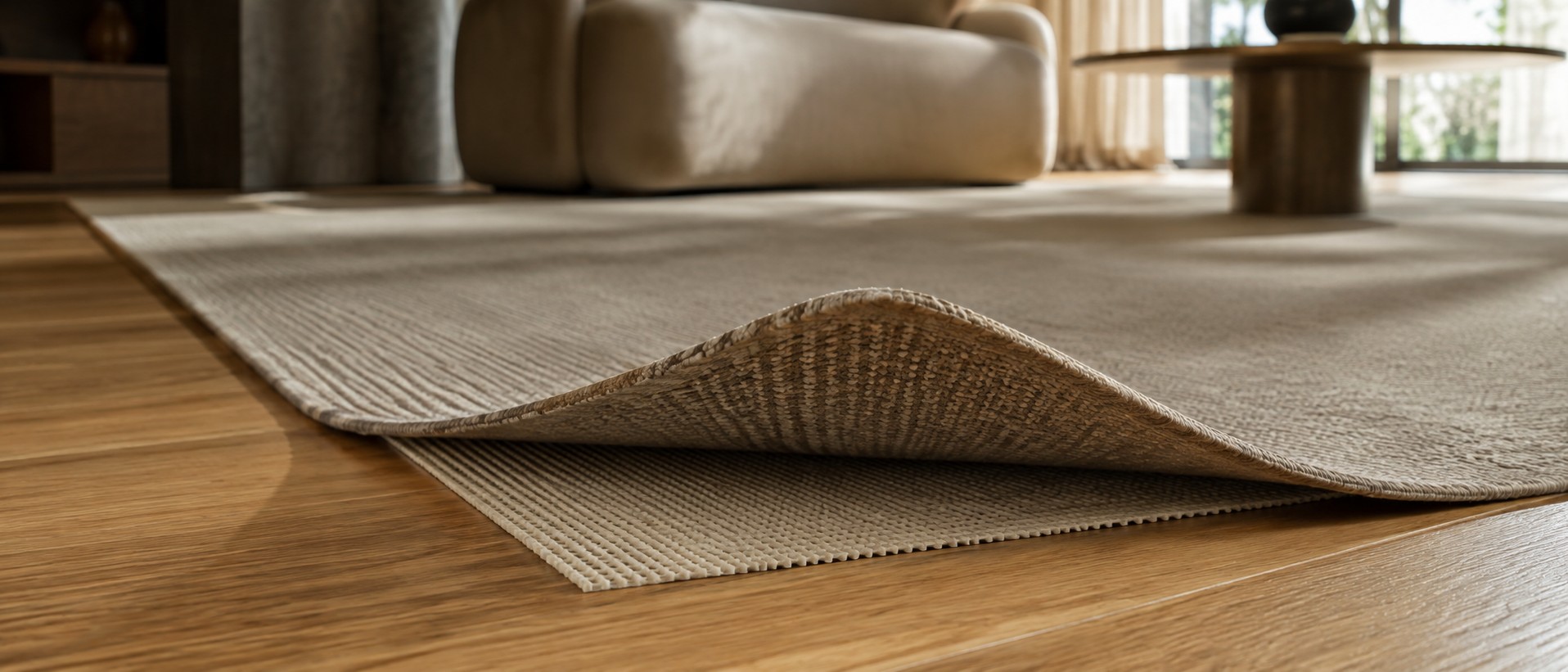
For most situations, the anti-slip underlay is the obvious choice. It is normally made from natural rubber, latex or PVC and is simply laid loosely underneath. No additional fastening is required.
The great advantage shows itself when cleaning: you separate the rug effortlessly from the underlay, and no adhesive residue remains on the rug or floor. To prevent the underlay from showing beneath the rug, cut it approximately 2.5 to 5 cm smaller all around than the rug edges. This way it disappears neatly under the rug while still providing support right up to just before the edge.
Going into detail on which underlay suits which floor type would go beyond the scope here. With smooth floors it is worth checking the material, as some plastics contain plasticizers that can attack sensitive surfaces. The precise selection by floor type can be found in the dedicated guide on choosing the right rug underlay.
Think about the backing already at the time of purchase
The simplest situation is when the problem never arises in the first place. There are rugs that come with a non-slip backing or material specification for wood, tiles or laminate as standard. If you know the rug will end up on parquet or in a walkway, that is a sensible criterion to consider.
Three points will help you choose:
- Backing: non-slip, or plan for a suitable underlay.
- Match size and intended location, especially in heavily trafficked areas.
- With thicker natural fiber rugs, allow one to two weeks from the start for the lying waves to relax.
If you keep these points in mind, the rug will stay where it belongs and you will no longer need to straighten it every morning.
FAQ
When does a sliding rug become a real tripping hazard and not just untidy?
It becomes critical in walkways, that is, everywhere people walk daily: the entrance area, in front of the bathroom, between kitchen and living room. Raised corners and waves in these zones become tripping hazards. Safety guides list the rug edge as a typical cause of falls, and the BFU recommends a non-slip underlay beneath the rug in the entrance area. Under a dining table, where few people pass, it is mainly a question of tidiness.
How much smaller should I cut the anti-slip underlay compared to the rug?
Approximately 2.5 to 5 cm smaller all around than the rug edges. This way the underlay does not show beneath the rug, yet still provides support right up to just before the edge. The underlay is laid loosely and requires no additional fastening.
How long does a new rug take to lie flat on its own?
As a rule, a few days up to around two weeks. Thin, low-pile and washable rugs usually lie flat within one to two days. Thicker rugs or natural fiber models made from wool or jute may need a week or longer. You can help it along by loosely rolling the rug in the opposite direction for several hours up to overnight.
Does rug tape damage my parquet?
Tape fixes permanently and can leave adhesive residue. Caution is therefore advised on sensitive floors. A loosely laid anti-slip underlay is more gentle on materials: it can be removed from the rug and floor without leaving any residue. If you do use tape, test it on an inconspicuous spot first.
What measure suits my bathroom mat on tiles?
Tiles are smooth, so small mats in particular tend to slide easily. First make sure the floor and mat are clean and dry. A correctly trimmed anti-slip underlay is the material-friendly standard solution and easy to remove again. Which underlay suits which floor type is explained in the guide on choosing the right rug underlay.