Rug on Underfloor Heating: Which Material Lets the Heat Through
A rug and underfloor heating can work together, with one condition
Laying a rug over underfloor heating (in Switzerland commonly called Bodenheizung) is entirely doable. The question is not whether it works in principle, but whether your specific rug is up to the job. A material that insulates too well slows down the heat output, forces your system to run harder, and can cause the floor surface to overheat. That damages the rug, stresses the construction below, and shows up on your energy bill.
The good news: there is exactly one number you need to understand. Once you know it, the rest follows logically.
The 0.15 rule: what the thermal resistance of a rug actually means
The thermal resistance of a material, written as R and measured in m²K/W, describes how strongly that material slows down heat flow. A higher R value means better insulation and less heat reaching the room above.
European standard EN 1264-4 governs the design and installation of underfloor heating systems. It sets the maximum allowed R value for all layers combined above the heating at 0.15 m²K/W. That figure is the planning limit used by installers across the EU and Switzerland alike.
The math behind it is simple. Take the thickness of a material in meters, divide it by its thermal conductivity in W/mK, and you have the R value:
R = d ÷ λ
Here, d is the material thickness in meters and λ (lambda) is the thermal conductivity in W/mK. A short-pile natural fiber rug at 8 mm thickness with a lambda of 0.06 W/mK gives: R = 0.008 ÷ 0.06 = 0.13 m²K/W. That clears the limit with room to spare.
One point that trips up a lot of buyers: the 0.15 m²K/W limit applies to the total stack, not to the rug alone. Add a rug at R = 0.12 m²K/W to a standard foam anti-slip pad at R = 0.06 m²K/W, and you land at 0.18 m²K/W, well above the threshold. More on that in the common mistakes section below.
Experienced floor layers typically work toward a target of around 0.10 m²K/W. That buffer leaves flexibility if you ever swap the rug or add a thicker underlay later.
Which materials and pile heights let heat pass through
Fiber type, pile density, and pile height all influence the R value, but they do not tell the full story on their own. A tall, airy pile can still clear the limit; a shorter, very dense one might not. The product datasheet is always the final word.
Good choices for underfloor heating
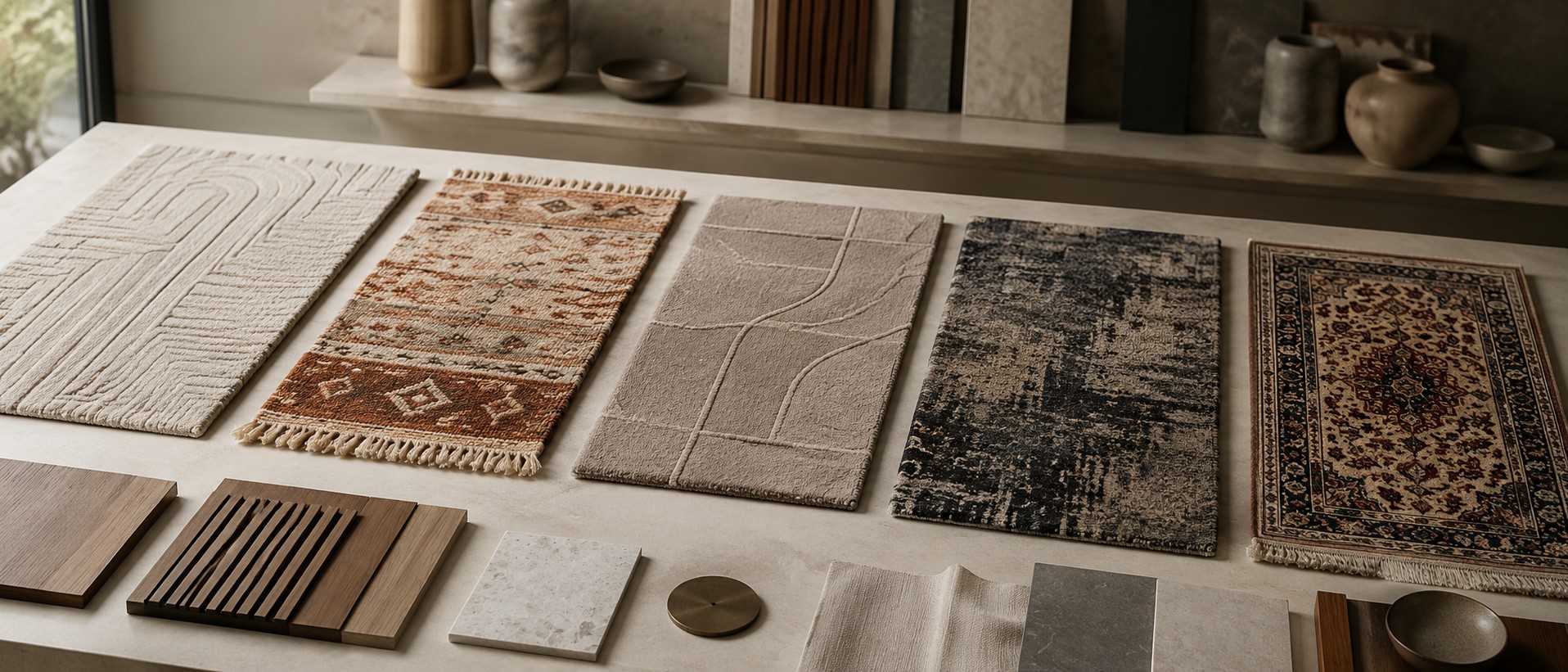
- Short-pile synthetic rugs (polypropylene, polyester): R values typically between 0.07 and 0.12 m²K/W, depending on thickness. The most reliable category for Bodenheizung use.
- Flat-woven natural fiber rugs (sisal, jute, cotton in rips or flatweave construction): usually around 0.12 to 0.15 m²K/W. Sisal bouclé can sit right at the boundary, so always check the datasheet.
- Indoor/outdoor rugs without a backing at roughly 5 mm thickness typically measure around 0.12 m²K/W.
- Thin woven wool rugs up to about 10 mm pile: 0.10 to 0.15 m²K/W, provided the weave is not too compact.
Rugs that are problematic or unsuitable
- Dense, heavy high-pile rugs: A loose, open high-pile construction at 30 mm can still come in under 0.15 m²K/W. A compact, heavy version of the same height routinely exceeds it. Always use the R value from the product data, not the pile height alone.
- Hand-knotted wool rugs and Berber rugs at around 15 mm or more: typical R values of 0.18 to 0.24 m²K/W, which puts them above the limit.
- Foam backing: High insulating effect plus a tendency to become flammable at elevated temperatures. Not suitable for any underfloor heating setup.
- Latex backing: Significantly restricts heat transfer. Also unsuitable.
- Jute or coconut backing combined with an already thicker rug: can push the combined value over the limit even without a separate underlay.
Pile height is a useful starting point, but it is the measured or calculated R value that determines whether a rug actually clears the threshold.
Fiber type and pile height: how common options compare
| Fiber | Pile height (approx.) | Typical R value (m²K/W) | Suitability |
|---|---|---|---|
| Polypropylene / synthetic | 5 bis 10 mm | 0.07 bis 0.12 | Well suited |
| Synthetic needle felt | 4 bis 5 mm | approx. 0.12 | Well suited |
| Indoor/outdoor, no backing | ~5 mm | approx. 0.12 | Well suited |
| Wool, flatweave / short pile | ~10 mm | 0.10 bis 0.15 | Suitable, check datasheet |
| Sisal / jute, flatweave | 5 bis 8 mm | 0.12 bis 0.17 | Conditionally suitable, check datasheet |
| Wool, Berber / Persian | ~15 mm | 0.18 bis 0.24 | Exceeds limit |
| High pile, dense (synthetic or wool) | 25 bis 40 mm | 0.15 bis 0.25+ | Generally unsuitable |
All figures are reference values. For any specific product, the R value in the product datasheet takes precedence.
Reading the label: the underfloor heating symbol explained
Many rugs carry a small symbol on the label that confirms suitability for underfloor heating use. It shows a black-and-white square with a heating coil along the bottom edge and three upward-pointing arrows above it. The arrows represent heat rising toward the room.
That symbol confirms three things at once: the rug has a low enough thermal resistance, it does not release harmful substances when warmed, and it can handle the temperature cycles that come with continuous heating operation. For reference, a well-designed underfloor heating system keeps the floor surface in living areas at around 26 to 29 °C.
Increasingly, newer products drop the classic pictogram entirely and print the R value directly on the packaging or in the datasheet. That approach is actually more useful, since a precise figure tells you exactly where you stand. When no symbol or R value appears on the product at all, contact the manufacturer before installation.
Quality marks that can signal tested suitability include the GUT label (Gemeinschaft umweltfreundlicher Teppichboden), the red "t" of the European Carpet and Rug Association (ECRA), TÜV environmental certification, and natureplus. These marks also cover emissions testing at elevated temperatures, which matters when a rug sits over active heating.
Common mistakes that push the total over 0.15 m²K/W
Mistake 1: Ignoring the anti-slip pad
A standard foam or rubber anti-slip pad carries an R value of roughly 0.05 to 0.10 m²K/W on its own. Combine that with a rug sitting at 0.12 m²K/W and you are already over the limit before you have even sat down on it. The fix is to choose an anti-slip underlay specifically made for underfloor heating: thin polyester fleece pads with an acrylic coating add barely anything to the total R value and still keep the rug from sliding.
Mistake 2: Laying a rug on top of laminate or parquet
Laminate itself contributes around 0.044 m²K/W to the stack. That leaves a maximum budget of roughly 0.106 m²K/W for the rug. Many mid-weight and thicker rugs exceed that figure, which means options narrow considerably. The same math applies to engineered parquet. Run the numbers before you commit to a purchase.
Mistake 3: Laying a rug with no symbol and no datasheet value
An absent label is not permission to proceed. If the manufacturer cannot supply an R value or confirm suitability, the risk of overloading the heating system is real. A Bodenheizung running against an oversized thermal load will cycle harder, age faster, and cost more to run.
Underfloor heating in Switzerland: a few specifics
Swiss convention uses Bodenheizung for what Germans call Fussbodenheizung. The concrete layer the heating pipes sit in is called the Unterlagsboden in Switzerland. In Germany that layer is the Estrich, but in Swiss German, Estrich refers to the attic space, so the two terms are not interchangeable.
Technically, the same European norm applies everywhere: EN 1264, with the 0.15 m²K/W ceiling for the total floor build-up above the heating. The Swiss building services association suissetec publishes its own technical guidance notes on thermal insulation beneath Unterlagsböden with Bodenheizung. Alongside EN 1264, the SIA norms 251 and 253 govern floating Unterlagsböden in Switzerland.
One Swiss-specific step worth knowing: before any floor covering goes down on a newly installed Bodenheizung, a mandatory Aufheizprotokoll (heating-up protocol) must be completed. The Unterlagsboden needs to be fully heated through and dried out, reaching a moisture content below 1.5 CM-% for cement screeds, before any rug or other covering is laid. Skipping this step can trap moisture and damage both the floor structure and the rug.
FAQ
Which rug is suitable for underfloor heating?
Any rug whose total thermal resistance stays at or below 0.15 m²K/W for the complete floor stack (rug plus any underlay combined) qualifies. In practice that points toward short-pile synthetic rugs and thin natural fiber options such as flat-woven sisal or jute. Look for the underfloor heating pictogram on the label or an R value in m²K/W in the product datasheet.
What does thermal resistance mean for a rug?
Thermal resistance (the R value, in m²K/W) measures how strongly a material slows heat flow. A higher number means more insulation and less warmth reaching the room. For underfloor heating systems, EN 1264-4 sets the maximum at 0.15 m²K/W across all layers above the heating pipes. Stay under that figure and the system heats efficiently; exceed it and performance drops while floor temperatures can climb.
Does the anti-slip pad count toward the 0.15 m²K/W limit?
Yes, every layer counts. A standard foam pad alone can add 0.05 to 0.10 m²K/W, which, combined with even a well-chosen rug, can push the total above 0.15 m²K/W. For underfloor heating use, choose a dedicated thin polyester fleece underlay with acrylic coating. These are designed to contribute almost nothing to the thermal resistance while still preventing the rug from shifting.
How do I recognize a rug that is approved for underfloor heating?
Two reliable indicators: the label pictogram (a black-and-white square showing a heating coil at the bottom and three upward arrows) or an R value stated directly in the product data in m²K/W. The numeric value is actually the more precise guide. If neither appears on the label or packaging, contact the manufacturer before laying the rug.
Is a high-pile rug possible on underfloor heating?
Usually not. A dense, heavy high-pile construction acts like a thermal blanket and typically produces R values above 0.15 m²K/W. A loose, open high-pile rug can sometimes clear the limit despite its height, but that depends entirely on pile density and fiber type. The only reliable check is the R value in the product datasheet. When in doubt, a tested short-pile model is the safer call.