Getting rid of an old rug without just throwing it out
The old rug's done, and the fastest fix would be to haul it to bulky waste and call it a day. Understandable. Only the easiest route is rarely the best, for your wallet or for the planet. A rug is a mix of materials that barely recycles, and at the same time plenty of old pieces still have enough life left for a second home. This guide runs through it in order: keep using it, give it away or sell it, upcycle it, and if none of that fits, dispose of it properly. With the actual Swiss routes and what they cost.
First question: is the rug still usable?
Before anything heads toward disposal, take a good look. Clean, whole and without heavy wear, the rug isn't trash, it's a find for someone else. Only when it's genuinely done, stained, walked flat, musty, does disposal come up. The whole guide follows that ladder: use it again first, hand it on next, dispose of it last.
Disposing of a rug in Switzerland: your municipality decides
As much as you might wish otherwise, there's no single nationwide rule. Where your rug can go and what it costs depends on your municipality. Four routes exist almost everywhere.
- Take it to the Werkhof yourself. Your municipal recycling yard takes the rug as bulky waste, usually charged by weight, roughly 20 to 40 centimes per kilo. You need a car and drive it there yourself, but it's the cheapest option.
- Book a bulky-waste collection. Many municipalities collect bulky waste, called Sperrgut, on request, with advance notice and usually a special sticker or fee. Handy without a car, but tied to fixed dates.
- Cut it into the trash bag. Small pieces cut down to size fit into the chargeable garbage bag, the Kehrichtsack. A whole rug does not belong there, though; that counts as bulky waste.
- Have a company pick it up. Disposal services collect the rug at home, with flat rates starting around CHF 120 and rising with weight, volume and floor. Convenient, but the priciest choice, and rarely needed for a single rug.
Because the rules are local, a quick look at your municipality's website pays off before you set out. The exact prices and whether a sticker is required are listed there.
Still good? Sell, give away or donate
A rug in decent shape is too good for the recycling yard. In Switzerland you'll move it on fast.
- Sell it. On Ricardo as an auction or buy-now, on Tutti as a classified. A few good daylight photos, clear measurements, and the rug finds a new spot.
- Give it away. A free listing on Tutti often finds a taker sooner than you'd think. Whatever you hand on for free, nobody has to dispose of.
- Donate it to a Brockenhaus. Brocki, the Salvation Army, Caritas and others accept well-kept rugs, and some even pick up sellable pieces. They only want it clean and undamaged, though; a trashed rug helps no one.
Does an old rug even get recycled?
The short answer: almost never. A rug is a bond of several layers. On top the wear layer of wool or synthetic, below it a backing fabric and a latex or adhesive base. Those layers are firmly joined and barely separate cleanly. The moment mixed fibers are involved, real material recycling is practically impossible. What's left is downcycling into simpler products or incineration.
Figures from Germany show the scale: only around three per cent of rugs there are recycled, and even that share is often just downcycled. Switzerland is hardly better off. There's no nationwide take-back system for private rugs; the circular programs a few manufacturers run are aimed at contract and commercial clients. Which is exactly why every alternative to the bin counts. One more thing from materials know-how: natural-fiber rugs in wool, sisal or jute biodegrade and are easier to recover at the end than pure synthetic. Think about the end of life while buying, and you'll have it easier later.
Upcycling: make something useful out of the old rug
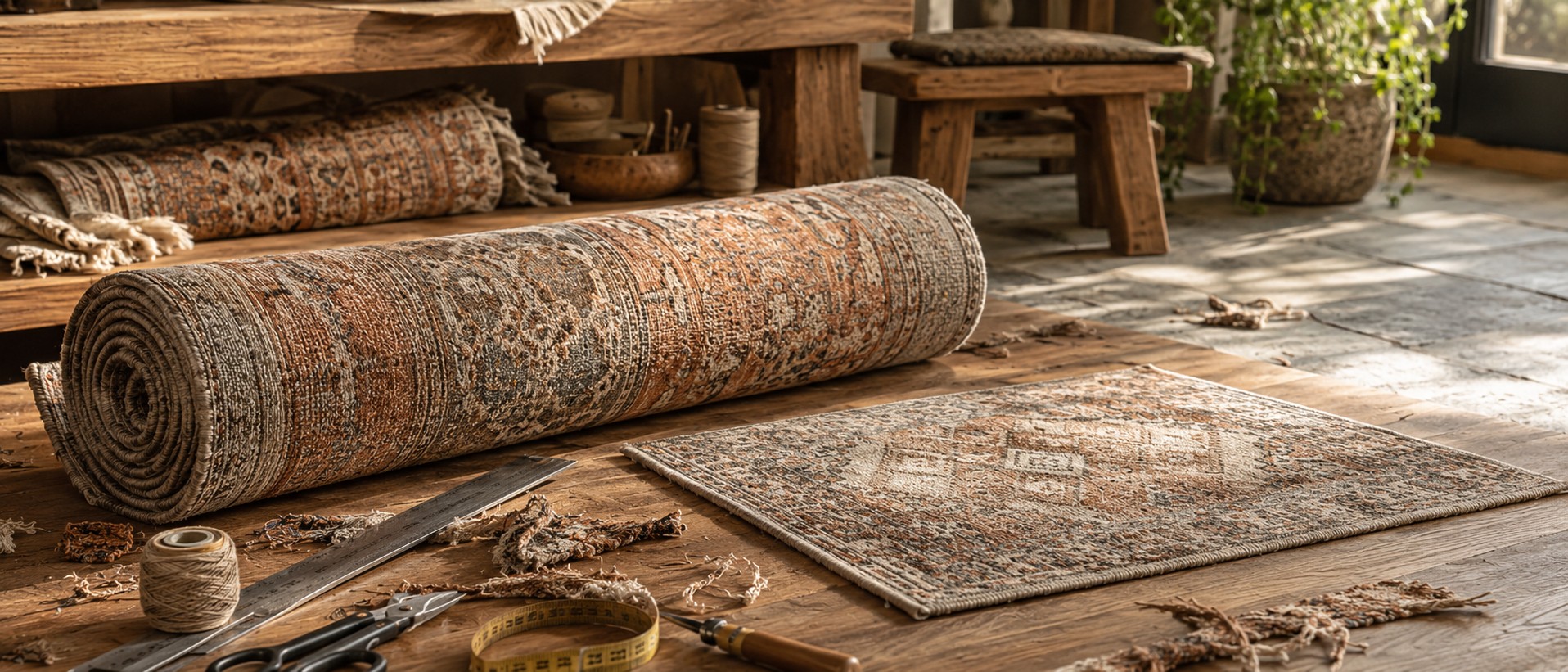
Before the rug goes for good, it's worth looking at what's still in it. Four ideas that work without special tools.
- A scratching mat for the cat. An offcut of sisal or jute, screwed to a board or the side of the couch, replaces the store-bought scratching rug. Cats love the coarse texture.
- A door or entrance mat. Cut a hard-wearing piece to entrance size, hem the edges or add anti-slip tape, and the dirt stays outside the door.
- Underlay for the cellar, garage or trunk. As floor protection in the workshop or as a cargo liner in the car, an old rug does years of service.
- Cut a runner. From a large rug worn in just one spot, a slim runner for the hall or kitchen still comes out. Fix the edges, done.
More creative, but just as doable: an offcut as a wall hanging that soaks up sound on the side, or strips as a draft stopper along the door.
The order that helps most
If you take one thing from this guide, take this ranking.
- Keep using it. The rug stays in service, with you in another room or with someone else.
- Give away or sell. Ricardo, Tutti, Brockenhaus.
- Upcycle. A second life as a mat, underlay or runner.
- Dispose of it properly. The Werkhof, a bulky-waste collection, or, cut down, the garbage bag.
Every step higher up saves resources and usually money too. The bin is the last option, not the first.
The bottom line
Getting rid of a rug is quick, but the short pause to think beforehand is worth it. If it's still good, someone else is glad of it. If it's done, a second life as a scratching mat or cellar underlay makes more sense than the incinerator. And if nothing else works, the route via the Werkhof takes it cleanly to the end. That way the old rug becomes not careless waste but a deliberate choice.
FAQ
Where does an old rug go in Switzerland?
A whole rug counts as bulky waste: either take it to the Werkhof yourself, usually charged by weight at roughly 20 to 40 centimes a kilo, or use your municipality's bulky-waste collection with advance notice. Small cut pieces can go in the garbage bag. Your municipality sets the exact rules and prices.
What does it cost to dispose of a rug?
At the Werkhof you usually pay by weight, about 20 to 40 centimes per kilo. A bulky-waste collection costs a sticker or fee depending on the municipality. If a company picks it up, flat rates start around CHF 120 and climb with weight and floor.
Can I cut a rug up to dispose of it?
Yes. Small, manageable pieces fit in the garbage bag, which is the simplest route for smaller rugs and offcuts. A large, whole rug still belongs in bulky waste, not the bag.
Do old rugs get recycled?
Barely. The firm bond of wear layer, backing fabric and base coat hardly separates, and with mixed fibers real recycling is practically impossible. In Germany only around three per cent are recycled, mostly just downcycled, and there's no take-back system for private rugs.
How do I move on a rug that's still good?
Selling on Ricardo or giving it away on Tutti is fast. Well-kept pieces are also taken by second-hand shops like Brocki, the Salvation Army or Caritas, and some even pick them up. The condition always has to be clean and undamaged.