Round rug styling: when the round shape really improves your room
Before you decide on a round rug, take a quick look around your room. What shapes are already there? Is there a round table, round mirrors or curved light fixtures, or do straight edges and rectangular furniture dominate? This question almost answers itself: whether a round rug makes your room more harmonious. And that is exactly what round rug styling is about: the language of shapes, not chance.
When a round rug suits your room
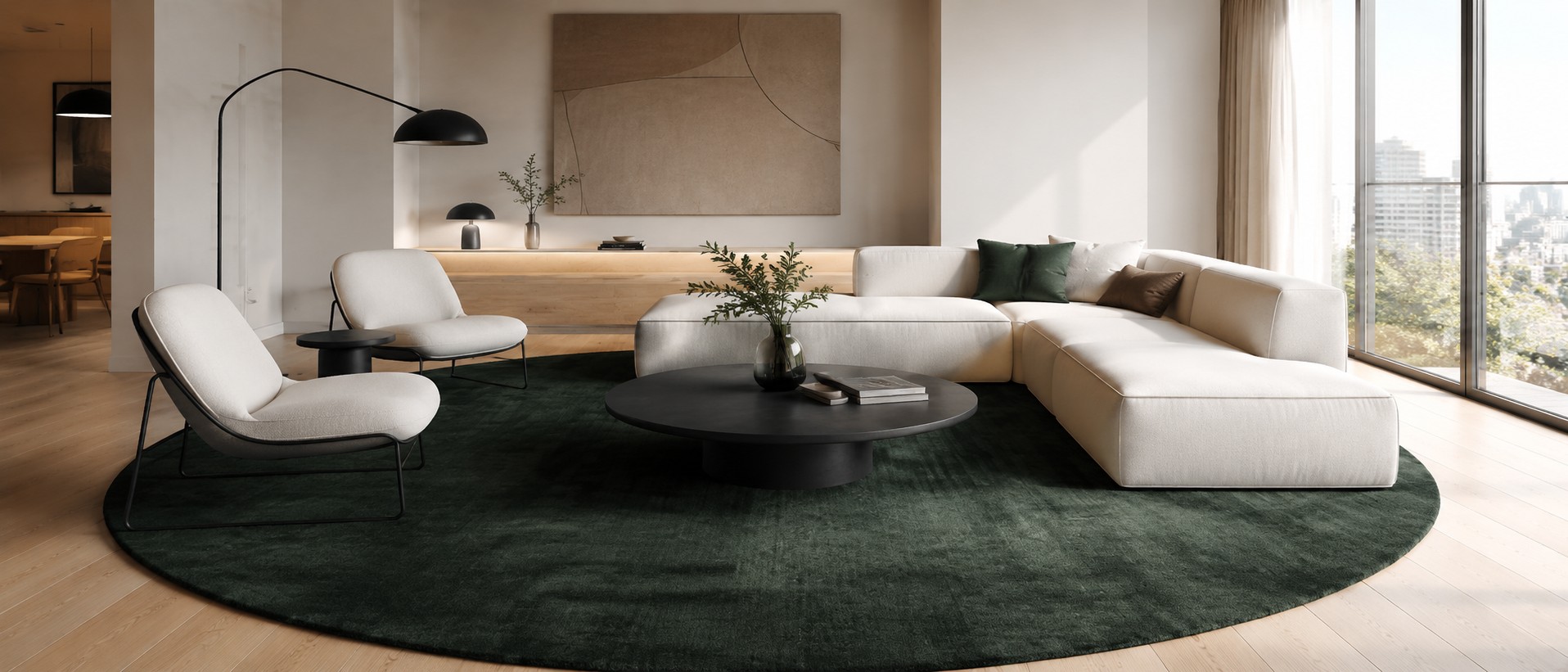
There are two situations in which the round shape works noticeably better than a rectangular one. The first: your room has many straight lines. Corner sofa, rectangular coffee table, cabinets along the wall. A round rug softens this strictness, feels more organic and draws the eye to the center. Instead of edge meeting edge, a soft counterpoint emerges.
The second situation: round elements are already present. A round coffee table, a round table in the dining area, round mirrors. The rug then reinforces the language of shapes that is already there and creates a calm unity. This shows particularly beautifully in the Scandi combination: a streamlined, clean sofa, a round coffee table and a round rug underneath. It looks modern and inviting because the soft shape and the clear line complement each other.
An everyday example: a living room with a corner sofa, rectangular coffee table and cabinets along the wall. Everything straight, everything strict. If you place a round rug in the seating group, the entire area gains a center that the eye can hold on to.
The front legs rule: the guiding principle for every placement
If you remember one single rule, make it this one: at least the front legs of your sofas and armchairs should stand on the rug. Only then does a visual connection between the furniture and the rug emerge. If the furniture stands completely beside it, the pieces look isolated and the room feels restless.
Interior designers use what is known as the four-two-zero rule: either all four legs of a piece of furniture stand on the rug, or exactly two (the front legs), or none at all. With three legs or just one, it looks as though the furniture is sliding off the rug. This front legs rule accompanies you through all the following sections, whether the topic is size or combining rugs.
Even a small overlap helps: if a piece of furniture stands on the rug by as little as around 25 cm, it visibly belongs to the zone. This is also how you define clear areas, such as a reading or seating corner in the living room. The rug creates a surface, gives the furniture a frame and makes the zoning in the room visible. This is especially valuable in open-plan layouts with a kitchen, dining area and living room.
The round table as the starting point for size
A round rug looks most harmonious under a round dining table. You calculate the size using a simple rule of thumb: table diameter plus 120 to 140 cm. This leaves an overhang of around 60 to 70 cm on each side.
An example: your round table has a diameter of 120 cm. You then need a rug of at least Ø 240 cm. For a smaller 4-person table with Ø 100 cm, a round rug with Ø 200 cm works well. The range for the overhang is between 60 and 75 cm depending on the source. The reason behind this matters: the chairs should still stand on the rug even when you push them back to sit down. Allow for a distance of at least 40 to 60 cm from the table edge so that the chair legs do not tip over the border.
| Table diameter | Recommended rug (Ø) |
|---|---|
| 100 cm | approx. 200 cm |
| 120 cm | at least 240 cm |
| 140 cm | approx. 260 cm |
Round rugs with corner sofas and rectangular furniture
Yes, a round rug works under rectangular furniture too. It breaks up the hard lines and feels pleasantly soft, especially with smaller seating groups or curved sofas.
With a corner sofa, the front legs rule still applies: slide the rug slightly under the sofa so that the front legs rest on it. How far you go is a matter of taste and ranges from one sofa arm to the entire seating corner. If only the front legs are on it, a margin of 15 to 30 cm relative to the sofa width is sufficient. If you place the rug only under the front legs, it should be roughly as wide as the sofa itself.
Whether the round rug sits centrally or slightly offset under a rectangular sofa is a question of style. Some prefer the central, calm placement; others find a slightly offset position under one corner more dynamic. Both are perfectly fine; try out what suits your room.
Eye-catcher instead of odd one out: anchoring it centrally
The most common mistake in round rug styling: it ends up somewhere in the room and defines no clear zone. It then looks like an odd one out. So think in zones first. Where is the sofa corner, where is the reading spot, where is the dining area? The rug belongs at the center of that use, and that is where it becomes an eye-catcher.
In a small living room, slide the round rug centrally a little under the sofa to anchor it visually. In larger rooms it can also lie freely in the center of the room, so that it appears to float between the sofa and armchairs. The coffee table on top connects the elements. Make sure the rug sits as centrally as possible: if it drifts too far to one side, the area looks unbalanced. A gap from the wall lets the floor breathe and frames the rug island.
The round shape also benefits the perception of space. Small rooms often feel larger and airier with a round rug, because the soft curve looks lighter than a hard edge. In a small room of around 15 to 20 square meters, place the rug in front of the sofa and put only smaller pieces of furniture such as a coffee table and stool on it. Depending on size, a diameter of 100, 120 or 150 cm is sufficient. Light tones feel understated and make the room appear visually more spacious.
A final word of caution: choose the rug generously. A round rug that is too small visually divides the room, feels restless and quickly looks lost. One that is too large dominates everything. The right size lies in between and is guided by your furniture.
Pile height and practicality in the dining area
For the dining area, it is worth considering the pile. A low pile is more practical here because chairs slide over it more easily. A high pile makes pushing chairs back harder and is more demanding to clean in everyday use. Under the round table, where people eat and move chairs every day, the front legs rule combined with a robust, low pile therefore shows its greatest strength.
FAQ
How large does a round rug under a round dining table need to be?
Take the table diameter plus 120 to 140 cm. A round table with Ø 120 cm therefore needs a rug of at least Ø 240 cm. This leaves an overhang of around 60 to 70 cm on each side, so that the chairs remain on the rug even when pushed back.
Do all furniture legs or only the front ones need to stand on a round rug?
At least the front legs should rest on it; that is enough for a visual connection. Interior designers use the four-two-zero rule for this: either all four legs, exactly two (the front legs) or none at all. With three or just one leg, it looks as though the furniture is sliding off the rug.
Does a round rug work with a rectangular sofa or room?
Yes. In rooms with many straight lines, a round rug breaks up the strictness and feels more organic. With a corner sofa, slide it slightly under the front legs, with a margin of 15 to 30 cm relative to the sofa width. Whether it sits centrally or slightly offset is a matter of taste.
Which pile height is suitable for a round rug under a dining table?
A low pile. Chairs slide more easily over a low pile, and it is simpler to clean in everyday use. A high pile makes pushing chairs back harder and requires more effort to maintain.
How much distance should a round rug have from the wall?
A gap from the wall lets the floor breathe and frames the rug island, giving the room proportion and airiness. A guideline is around 45 to 60 cm. More important than the exact figure is that the rug sits as centrally as possible and is not pushed into a corner.