Real Rug or Good Imitation? How to Spot the Difference in Five Minutes
What "genuine" really means in the rug trade
After more than thirty years in the rug business, one question comes up again and again: "Is this rug really handmade?" The answer sounds simple, but is full of nuance. In the trade, "genuine" almost always refers to handcrafted goods, meaning a rug whose knots have been tied individually by hand. It is not an automatic judgement about age, origin or price. A genuine, hand-knotted rug can be young, affordable and of modest quality. And an expensive rug from a boutique can be machine-made despite its high price tag.
Once you understand this, you buy with greater clarity, compare more effectively and are less impressed by crossed-out "fantasy prices".
The 5-minute check: What you can see and feel on the rug itself
1. The back: The most honest face of a rug
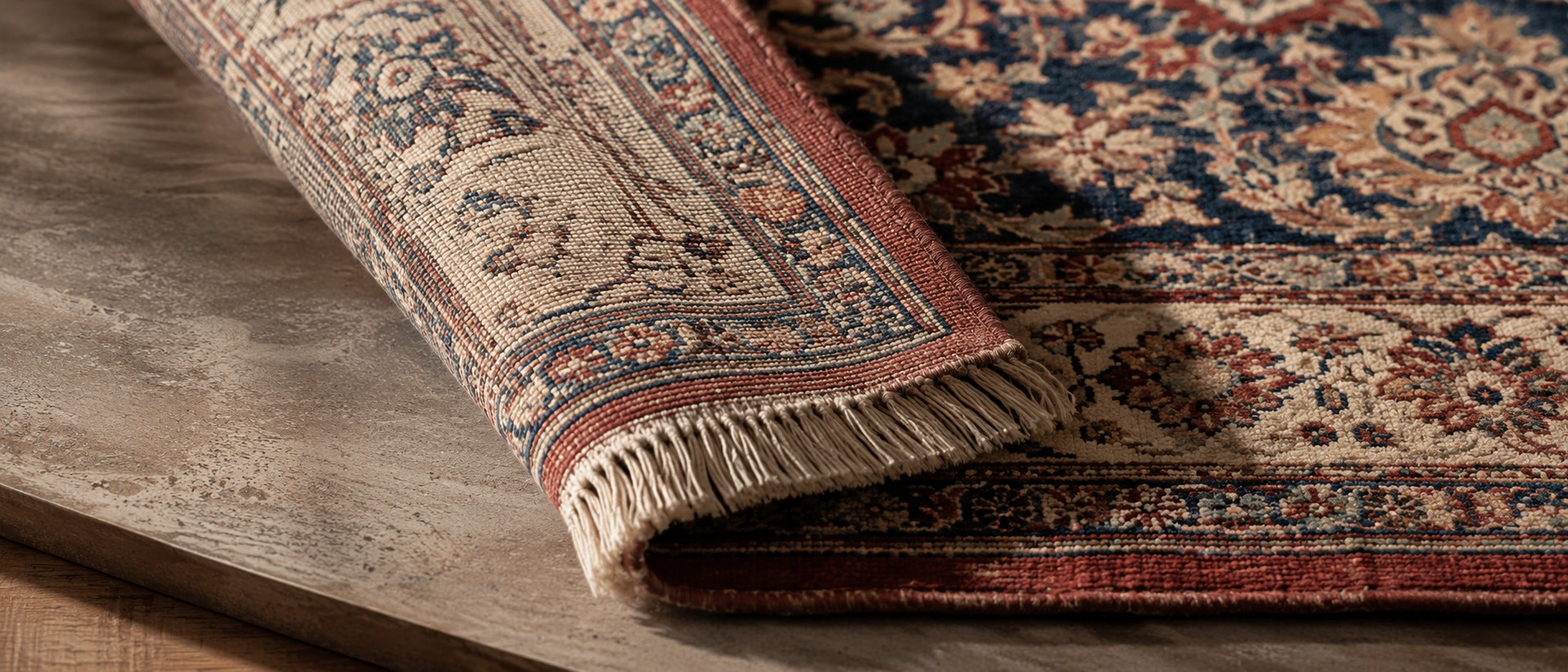
Turn the rug over. On a hand-knotted piece, you will see the knot pattern on the back: individual, slightly irregular knots arranged in rows, but never appearing mechanically perfect. Small variations in spacing, occasionally a minimally offset knot, are not a flaw but a sign that a human being has worked here. Machine-made goods, by contrast, show an exactly uniform, repeated pattern reminiscent of a woven textile. The back never lies.
2. Fringes: Grown or sewn on?
Real fringes are not decoration. They are the extended warp threads of the foundation weave, an organic part of the rug. If you pull on a fringe and it feels directly connected to the weave, that speaks for handwork. Fringes that appear neatly sewn on or glued are a clear signal of industrial production. Examine the transition between the fringe edge and the back closely.
3. Pattern and symmetry: Slight deviation as a quality feature
Perfect symmetry sounds like quality, but in hand-knotted rugs it is rather unlikely. A skilled knotmaker works from a template or from memory, and even with great care, minimal irregularities arise in the ornament, the line work or the medallion. Such deviations are an indication of handwork. A machine-made rug, by contrast, repeats its pattern with pixel-perfect precision.
4. Material: Reading with your fingers
Traditional oriental rugs consist almost exclusively of natural materials: sheep's wool, cotton, camel hair or silk. Wool feels warm and slightly greasy, silk cool and smooth. Synthetic fibres often feel more uniform, cooler and less lively. Particular caution is warranted with the back: a latex layer or a glued backing material is a strong sign of machine-made or hand-tufted goods, not genuine hand-knotting.
Hand-tufted, incidentally, means: a craftsman shoots loops of yarn into a backing fabric using a gun. That is handwork, but not hand-knotting. The difference in terms of durability and value is considerable.
5. Abrash: Colour variation as a signal of authenticity
Look closely into a seemingly uniform colour area, for example the blue of the central field. Do you see slight colour differences, lighter or darker zones within the same colour? That is called abrash and occurs when the knotmaker has used different yarn batches or dye baths. In hand-knotted rugs with natural plant dyes this is virtually unavoidable and is regarded in many places as a quality feature. Strong, abrupt colour changes, however, can indicate later repairs or fading. When in doubt, a second look at the back helps.
Knot density in the right context
Many buyers ask about knot density first, and that is understandable: a high number of knots per square centimetre allows for finer patterns, requires more time and speaks to the level of craftsmanship involved. Fine pieces from Qum or Nain can reach several hundred knots per square centimetre, while coarse tribal rugs may have around twenty.
However, knot density alone is not a value judgement. A rug with eight hundred knots per square centimetre made from inferior, poorly dyed wool can be worth less than a coarse tribal rug made from high-quality new wool with natural plant dyes. Age, origin, condition, material and knotting technique all count equally. Focusing solely on the knot count means missing the full picture.
Real Persian rug: A term with limits
In the strict sense, a Persian rug is a hand-knotted rug from Iran, from one of the classic knotting regions such as Tabriz, Nain, Bijar, Kashan, Kerman or Isfahan. Not every oriental rug is a Persian rug, and not every rug from Iran is automatically of high quality. The term says something about origin, but only in combination with material, knotting technique and condition does a picture of value emerge.
At auctions, with inherited pieces or flea market finds, it is therefore worth questioning statements of origin. Labels and descriptions can be incorrect or exaggerated. The physical characteristics of the rug itself are more reliable than any certificate without proof.
When is a real rug not automatically valuable?
This is perhaps the most important point I have had to emphasise repeatedly after decades in the trade. "Genuine" and "valuable" are two different statements. A hand-knotted rug can:
- be heavily worn or damaged
- consist of cheap, low-durability wool
- be dyed with chemical colours that fade quickly
- come from a region whose production is in little demand
- feature a design that finds few buyers on the market
Genuine handwork is a quality feature. It is not, however, a guarantee of high prices. An independent expert can help with costly individual pieces to assess the actual value.
Which photos do I need for an assessment?
Anyone buying a rug online or wishing to have an inherited piece appraised should provide at least the following images:
- Full back: for the knot pattern and basic construction
- Close-up of the fringe edge: to assess whether the fringes grow organically from the weave
- Macro shot of the surface: for pile height, sheen and fibre texture
- Colour areas in bright light: to make abrash visible
- Any labels or certificates that may be present
With these images, an experienced dealer or appraiser can already provide a well-founded initial assessment from a distance. For valuations that are relevant for legal or insurance purposes, an on-site inspection is always required.
A brief comparison: Hand-knotted vs. machine-made
- Back: Hand-knotted shows visible, slightly irregular knots. Machine-made has a uniformly woven pattern.
- Fringes: Hand-knotted fringes arise from the warp threads. Machine-made rugs often have sewn-on or glued fringes.
- Pattern: Hand-knotted shows minimal deviations. Machine-made is pixel-perfectly symmetrical.
- Material: Hand-knotted mostly natural materials. Machine-made frequently synthetics or latex backing.
- Abrash: Hand-knotted with natural dyes often shows slight colour nuances. Machine-made is uniformly dyed.
- Price per quality: Hand-knotted varies greatly depending on material, origin and condition. Machine-made is usually less expensive to produce.
FAQ
How do I identify a genuine hand-knotted rug?
The most reliable test is a look at the back. On a hand-knotted rug you will see individual, visible knots arranged in a slightly irregular fashion. No knotmaker works with mechanical precision, so the perfect uniformity that characterises machine-made goods is absent. The fringes also provide information: real fringes arise as a natural extension of the warp threads from the foundation weave. In addition, hand-knotted pieces often show minimal deviations in the pattern that do not occur in machine-made goods.
Are sewn-on fringes an indication of machine-made goods?
Often yes. On genuine hand-knotted rugs, including classic oriental rugs and Persian rugs, the fringes are an organic part of the weave. They arise because the warp threads extend beyond the knotting field and are finished off. Fringes that appear neatly sewn on or glued and feel visually like an addition usually come from machine-made goods. A close look at the transition between the fringe edge and the back quickly reveals whether they have grown from or been added to the rug.
Does high knot density automatically mean high quality?
No. Knot density is an important indicator of the effort and fineness of a rug, but it is not a complete quality judgement. A rug with a very high knot count made from inferior wool or poor dyes can be less durable and less valuable than a coarse tribal rug made from high-quality new wool with natural plant dyes. Material, dyeing, origin, knotting technique and condition all feed into the assessment. Focusing exclusively on the knot count gives an incomplete picture.
How do I identify a genuine Persian rug?
A genuine Persian rug is hand-knotted and comes from Iran, from one of the traditional knotting regions such as Nain, Tabriz, Bijar, Kerman or Kashan. It typically consists of natural materials such as sheep's wool, cotton or silk. The back shows the characteristic knot pattern of handcrafted work. Importantly, not every oriental rug is a Persian rug. Oriental rugs come from a much larger geographical area, including Afghanistan, Turkey, Pakistan or India. Labels alone are not sufficient as evidence; the physical characteristics of the piece itself are what matters.
What is abrash and is it a defect?
Abrash refers to slight colour variations within a seemingly uniform colour area, for example lighter or darker zones in the blue of the central field. They arise when the knotmaker uses different yarn batches or dye baths, which is virtually unavoidable in handmade rugs with natural plant dyes. In specialist terminology, abrash is often regarded as an indication of genuine handwork and natural dyeing. It is not a defect. However, abrupt, very strong colour changes can also indicate later repairs or uneven fading. When in doubt, a look at the back is worthwhile to identify repair areas.