Reading asymmetric knots in a rug and verifying your purchase yourself
Why false claims in the rug trade make it worth knowing about asymmetric knots
In the Oriental rug trade, a great deal is asserted. The Swiss «Kassensturz» program has repeatedly reported cases in which origin and knot density were stated incorrectly, and K-Tipp regularly receives disputes about overpriced rugs with embellished descriptions. Anyone who truly wants to assess a piece must be able to verify the dealer's claims independently. This is precisely where asymmetric knots, also called Senneh knots, Persian knots or Sennehbaff, prove useful.
The knot describes not the pattern but the way in which the pile yarn is wrapped around the warp threads. With the asymmetric knot, the wool yarn encircles two warp threads so that only one end is pulled upward between them, while the other runs freely alongside. One warp thread is thus fully encircled, while the neighboring one is only partially so. Hence the name «asymmetric». Once you can read this on the back of a rug, you are far less likely to be misled by false claims about provenance or density.
How to open the pile and read the knots on the back
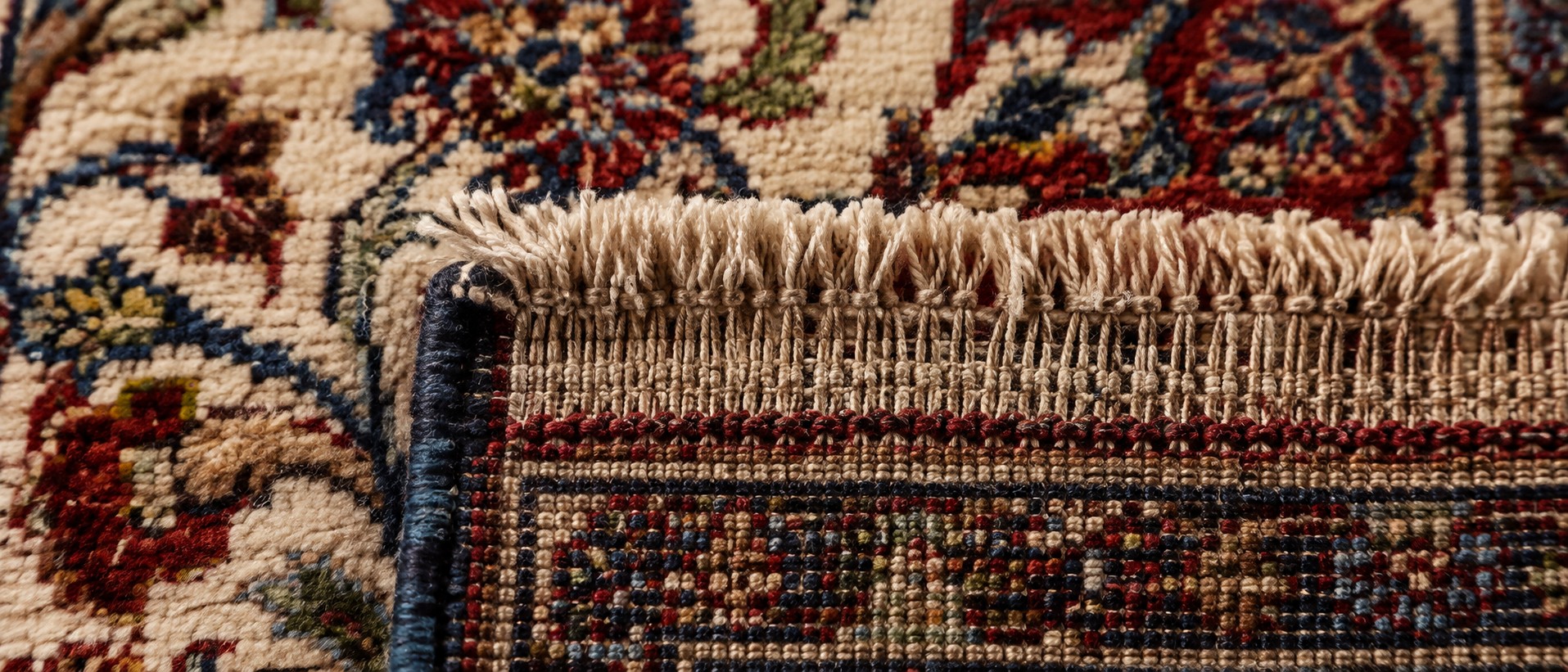
The knotting technique is best identified by carefully bending the pile perpendicular to the direction of the warp threads, that is, against the grain. This exposes the base of the knot and allows you to see how the yarn is guided around the warp threads.
You can do this directly in the store. Imagine a buyer opening the pile against the grain and seeing only a single loop over the warp thread. That is an indication of the Senneh knot. With the asymmetric knot, the fully encircled warp thread lies on the underside of the rug.
A small detail on the side: in Persian rugs, asymmetric knots usually open to the left, while in Turkmen pieces they more often open to the right. Depending on the tradition, the free yarn end may therefore protrude on one side or the other of the warp thread.
One or two loops: what you actually see in the knot pattern
The rule of thumb for the back is straightforward. If you see only one loop or bump over the warp thread, it is most likely the Senneh knot. If two loops are visible, it is probably the Ghiordes knot, that is, the symmetric or Turkish knot, in which both warp threads are fully encircled.
To help you distinguish clearly between the two techniques, here is a direct comparison:
| Feature | Asymmetric knot | Symmetric knot |
|---|---|---|
| Other names | Senneh knot, Persian knot, Sennehbaff | Ghiordes knot, Turkish knot |
| Encirclement | One warp thread fully, the other partially | Both warp threads fully |
| Typical design | Often fine, flowing lines and floral details | Frequently bold, geometric forms |
| Quality statement | Essentially equivalent | Essentially equivalent |
| Back identification | One loop over the warp thread | Two loops over the warp threads |
For context: the Persian knot offers more design possibilities with softer lines, while the Turkish knot is often found in geometric patterns. This is a tendency, not a fixed rule. Pattern, material, knot density and the skill of the knotter all play a role. Old rugs from western Persia such as Tabriz, Heriz or Bidjar, for example, are knotted with the Turkish knot.
The name Senneh says nothing about the city of origin
A misunderstanding that repeatedly causes confusion: the name «Senneh knot» does not mean that the rug comes from the city of Senneh, today known as Sanandaj. On the contrary. In that eponymous city, the tradition was to knot with the symmetric, that is, the Turkish knot. Why the asymmetric knot nevertheless bears the name of this city has not been explained to this day.
What is certain: the knot was not «invented» in Senneh and is not confined to Persia. The technique is widespread in all regions where rugs are knotted by hand. Some peoples even use both knotting types, occasionally within the same rug. The knotting technique can therefore give you a hint about a knotting tradition or region, but on its own it is not sufficient as proof of origin.
Hand-knotted or machine-made: the back tells the story
Whether a rug was knotted by hand is also revealed by the back. On a handmade piece, the individual knots and the pattern are clearly visible. On machine-produced rugs, the pattern on the back is less distinct and individual knots cannot be made out.
A further sign: if every row of knots on the back is absolutely regular and flawless, that points to machine production. And the fringes. On a hand-knotted rug, they are part of the warp threads that hold the knots together. Important: both the asymmetric and the symmetric knot are purely hand-knotting techniques. The knot type alone therefore does not indicate whether it was made by hand or by machine.
Checking knot density without being deceived by a blender
The number of knots is an important factor in quality, but only one of many. For orientation, here are some ranges: robust nomadic rugs have 50'000 to 150'000 knots per square meter, good workshop rugs 250'000 to 500'000, and the finest pieces from Nain, Isfahan or Ghom reach well over one million per square meter. As an indication of the time involved: a Persian rug of 300 x 400 cm with 500'000 knots per square meter requires around 600 days of handwork.
More knots do not automatically mean a better rug. The density must suit the style. A richly detailed floral medallion requires a high knot count; a geometric nomadic pattern can manage with fewer. Take a Gabbeh with 80'000 knots per square meter that is cleanly worked for its provenance. For a Nain that would be coarse; for a Gabbeh it is very fine. This is why knot density can only be used as a quality criterion within a given provenance.
Two warning signs from practice. First: a Persian rug is offered as a Nain with a very high knot density, but the back shows suspiciously regular rows. That sits poorly with genuine handwork. Second, the «blender». This is a wool rug with a conspicuously dense knot structure whose yarn feels dull because cheap or old material was used instead of fresh virgin wool. Despite a high knot count, such a piece wears out quickly.
Your inspection sequence before buying a wool rug
Before you make a decision, it is best to proceed in this order:
- Expose the back: Bend the pile against the grain and check whether individual knots are visible. This separates handwork from machine production.
- Read the knot pattern: One loop points to the Senneh knot, two loops to the Ghiordes knot. Both are equivalent in quality.
- Check regularity: Perfectly even, flawless rows of knots are an indication of machine production.
- Assess density in context: Always evaluate knot count in relation to the stated provenance, never in absolute terms.
- Feel the yarn: Dull, lackluster wool at high density is a warning signal for a blender.
- Overall picture: Material, dyeing, pile, edges and evenness together form the final judgment.
By going through these steps, you verify the dealer's claims with your own eyes rather than simply trusting a label. The knotting technique is a craft characteristic and a valuable pointer, but not a blanket seal of quality.
FAQ
How do I tell from the back whether a rug was knotted with a Senneh or Ghiordes knot?
Bend the pile against the grain and count the loops over the warp thread. One loop points to the Senneh knot, that is, the asymmetric knot. Two loops indicate the Ghiordes knot, the symmetric knot. This exposes the base of the knot and makes the encirclement visible.
Does Senneh knot mean the rug comes from the city of Senneh?
No. In the eponymous city of Senneh, today known as Sanandaj, the tradition was to knot with the symmetric Turkish knot. Why the asymmetric knot nevertheless bears this name has not been explained. The technique is widespread in many regions and on its own is not sufficient as proof of origin.
How can I tell whether a rug is hand-knotted or machine-made?
On a hand-knotted rug, individual knots and the pattern are clearly visible on the back, and the fringes are part of the warp threads. Absolutely regular, flawless rows of knots, by contrast, point to machine production. Both the asymmetric and the symmetric knot are purely hand-knotting techniques.
Is a rug with a high knot density automatically better?
No. Density is only one of many factors and must suit the style. A geometric nomadic pattern does not need a million knots; a richly detailed floral medallion does. Always compare knot density within a given provenance, because what is coarse for a Nain can be very fine for a Gabbeh.
What is a blender and how do I protect myself from one?
A blender is a rug with a high knot or tuft density for which cheap yarn or old wool was used instead of fresh virgin wool. Despite dense knotting it is inferior in quality and wears out quickly. Feel the wool: dull, lackluster yarn at high density is a warning signal.