How a rug is made: from the first thread to the finished piece
How a rug is made when a piece takes months or years
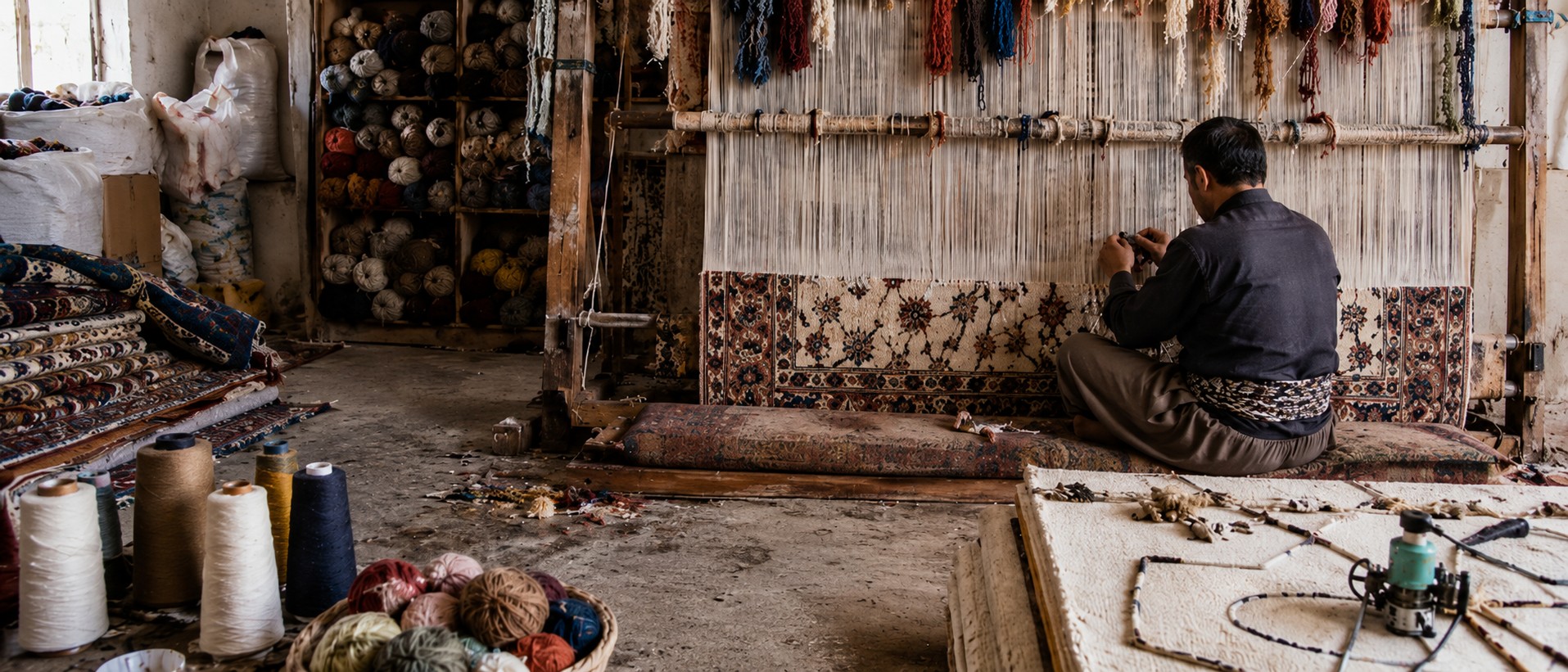
Imagine ordering something and waiting two years for it. With a hand-knotted rug, that is not a delay but the norm. Depending on size and knot density, such a piece takes anywhere from six months to several years to complete. And that counts only from the first row of knots onward. Before that comes all the material preparation: wool harvesting, washing, combing, spinning, and dyeing with plant-based colors.
That is precisely why it is worth understanding rug making before you buy. Anyone who knows how a rug is made can assess price, appearance, and durability much more easily. The short answer to how rugs are made: there are three main approaches, and they differ enormously in terms of time, skill, and result.
The foundation is nearly the same in almost all cases. Warp and weft form the base weave that gives the rug its structure. The warp runs lengthwise and is stretched onto the knotting loom first. The weft thread runs crosswise, alternating over and under the warp. Warp and weft are usually made of cotton. The pile is the walkable surface, meaning the upward-facing ends of the knotted loops. A rug consisting only of warp and weft without pile is called a kilim.
Knot density makes the difference: what lies behind 100'000 to over 1'000'000 knots
The most important figure for a hand-knotted rug is knot density. The more knots per square meter, the finer the pattern and the more valuable the piece. A genuine hand-knotted rug can have anywhere from 100'000 to over 1'200'000 knots per square meter.
What this means for production time can be illustrated with a calculation. A Persian rug measuring 2x3 meters with 300'000 knots per square meter amounts to around 1.8 million knots. A skilled hand can tie several thousand to roughly ten thousand knots per day, depending on fineness. A larger piece of 300 x 400 centimeters with 500'000 knots per square meter requires around 600 days.
Figures vary considerably between sources. At 100'000 knots per square meter, roughly one year should be expected; at 225'000 knots, three to five years. Treat these values as a range, not an exact formula. What matters is the order of magnitude: fineness costs time, and time is ultimately reflected in the value.
How fineness shows in the pattern
Very coarse rugs start at around 40'000 knots per square meter, where the pattern remains simple and flat. A fine Tabriz 70 Raj with over 1'000'000 knots per square meter, by contrast, can display filigree ornaments, soft curves, and delicate color gradients. The smaller the individual knot, the more precisely the design can be drawn, much like an image with high resolution.
Senneh knot and Ghiordes knot: two ways to bind every fiber individually
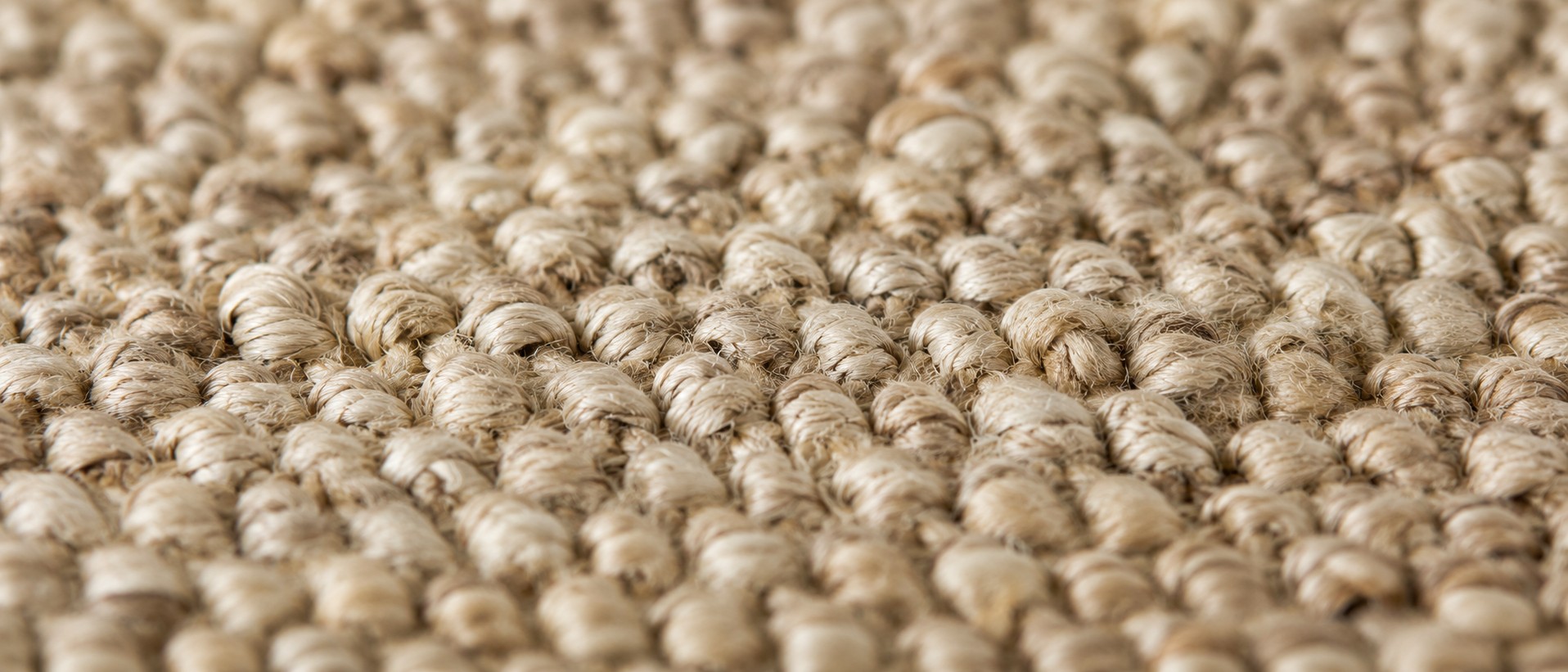
In knotting, every pile thread is tied individually around the warp threads. In Oriental rugs, two main types of knots are distinguished. The Persian Senneh knot is asymmetrical; the Turkish Ghiordes knot is symmetrical. Both bind every fiber permanently to the warp.
That is precisely what makes hand-knotted rugs so durable. Because every fiber is anchored individually and firmly, they shed very little and often last for generations. Once finished, the rug is taken off the loom, washed (which affects color intensity and texture), and after drying is trimmed once more with scissors to an even pile height.
From fleece to yarn: wool harvesting, washing, combing, spinning, and dyeing before the first row
Before a single knot is tied, a great deal happens. The wool is harvested, washed, combed, and spun into yarn. Only then comes the dyeing, which in traditional rugs is often done with plant-based dyes. This preparation is a craft step in its own right and one of the reasons a hand-knotted rug cannot be made in a matter of hours.
Wool is the most popular natural fiber in rug making. It is naturally dirt-repellent, thermally insulating, elastic, and hard-wearing. It also has a positive effect on the indoor climate: wool can absorb around 33 percent of its own weight in moisture without feeling wet. This regulates humidity and temperature in the room.
Weaving, knotting, and tufting compared directly
The three techniques result in very different rugs. In weaving, warp and weft threads are interlaced; a woven rug has no pile. A kilim, for example, shows the same pattern on both the front and the back and can be used on either side, which makes it robust. In knotting, every pile thread is tied individually, resulting in thicker rugs. In tufting, the yarn is pushed into a pre-made backing fabric using a tufting gun or by machine. The principle is based on the sewing machine and became established industrially in the 1950s.
In tufting, the needle pierces the material from the back; on the front, a loop is formed. If the loop is cut, the result is velour; if left intact, it produces loop pile. To stabilize tufted rugs, the underside is rubberized. This is why they cannot be washed.
| Technique | Construction | Time and price | Suitability |
|---|---|---|---|
| Weaving | Warp and weft interlaced, no pile | more time and craftsmanship, more robust | high-traffic areas such as hallways or hotel lobbies |
| Knotting | every pile thread individually knotted | months to years, highest value | highest quality, long-lasting across generations |
| Tufting | yarn needled into backing fabric, rubberized underside | fast and cost-efficient | soft living rooms and bedrooms, great design flexibility |
Since the industrialization of looms in the 19th century, production time for machine-made rugs dropped to around one hour per rug. Tufted rugs are therefore faster and less expensive; woven rugs require more time and skill but last longer. Industrial wall-to-wall carpet today is almost never woven or knotted but tufted, with the yarn shaped into loops by grippers.
Material determines care and lifespan: wool, natural fibers, synthetic fibers
The material determines how you care for the rug and how long it lasts. A brief overview.
Wool and natural fibers
- Wool: dirt-repellent, thermally insulating, elastic. Some shedding from wool is a normal characteristic of the natural product, not a defect.
- Cotton: resistant to dirt, usually washable, and in some cases even machine-washable.
- Sisal: anti-static, does not attract dust, and provides good impact sound insulation. Sisal must not get wet, however, as it will lose its shape or rot.
Natural fibers are biodegradable; wool, cotton, and sisal are even fully compostable.
Synthetic fibers
- Polypropylene: water-repellent, dirt- and stain-resistant, making it well suited for damp rooms. It does wear out relatively quickly and is easily flammable.
- Polyamide (nylon): makes the fibers flexible and resilient, keeping the rug soft and increasing its longevity.
- Polyester: long-lasting; many variants are now made from recycled PET.
As a rough guide: high-quality natural fibers such as wool often last 15 to 25 years, while synthetic options made from polypropylene tend to last 5 to 10 years. These figures come from a single source and should be understood as indicative values. Regarding indoor air quality, synthetic fiber rugs are considered unremarkable according to Stiftung Warentest: they emit virtually no harmful substances. In a test of 50 rugs, none typically posed a health risk, though one in three still had an unpleasant smell after four weeks. Anyone who wants to be certain should look for the Blue Angel certification, as recommended by Deutsche Umwelthilfe.
Which rug suits which home: craftsmanship, everyday use, or budget
In the end, what counts is what suits you. For the highest quality and longevity, hand-knotted rugs are the clear choice. A wool rug can be cleaned and repaired almost indefinitely. Think of a family passing such a piece down through generations: that is exactly the value embedded in the handwork. For natural living styles, hand-woven rugs are a fitting option; for modern design and DIY trends, tufted rugs offer a soft structure and great design freedom.
A few practical rules of thumb:
- High foot traffic such as hallways or entrances: woven rugs, because their structure is more robust.
- Living rooms and bedrooms focused on comfort: tufted rugs or wool rugs.
- Damp rooms: polypropylene, because it is water- and stain-resistant.
- Quality and lasting value: hand-knotted pieces, from the classic Persian rug to the modern designer rug or limited edition rugs.
Whether you choose craftsmanship, everyday practicality, or a tighter budget: when you understand how a rug was made, you make your choice with full knowledge of what you are buying.
FAQ
How long does it take to hand-knot a rug?
Depending on size and knot density, anywhere from six months to several years. A piece measuring 300 x 400 centimeters with 500'000 knots per square meter requires around 600 days. Figures vary between sources: at 100'000 knots per square meter, roughly one year should be factored in; at 225'000 knots, three to five years. On top of that comes the preparation work of washing, combing, spinning, and dyeing, all before the first row of knots.
How can I tell whether a rug is hand-knotted?
In hand-knotted rugs, every pile thread is tied individually around the warp threads, usually as a Persian Senneh knot (asymmetrical) or a Turkish Ghiordes knot (symmetrical). Because every fiber is firmly anchored to the warp, these rugs shed very little and can be cleaned and repaired almost indefinitely. Tufted rugs, by contrast, have a rubberized underside and cannot be washed.
What does knot density say about quality?
The more knots per square meter, the finer the pattern and the more valuable the rug. Coarse pieces start at around 40'000 knots per square meter, while the finest rugs such as a Tabriz 70 Raj feature over 1'000'000 knots. Higher density allows for more intricate patterns and at the same time means more production time, which is reflected in the value.
Why do wool rugs shed and is that a defect?
No, it is not a defect. Shedding from wool is a normal material characteristic of the natural product and diminishes over time. Wool has many advantages: it is dirt-repellent, thermally insulating, and elastic, and can absorb around 33 percent of its own weight in moisture without feeling wet. This has a positive effect on the indoor climate.
Which material is easiest to care for: wool or synthetic fiber?
For straightforward maintenance, synthetic fibers are often more practical: polypropylene is water-, dirt-, and stain-resistant and is even suitable for damp rooms, though it wears out more quickly. Wool is naturally dirt-repellent and lasts a long time with proper care, but sheds slightly and requires careful treatment. Cotton rugs are resistant to dirt and are in some cases even machine-washable.