Alum Mordant: the metal salt behind permanently vibrant wool rugs
Alum Mordant: the metal salt behind permanently vibrant wool rugs
You are standing in a specialty store, looking to buy a rug, and at some point the term alum mordant comes up. With naturally dyed wool rugs it appears almost every time. Why? Because it is precisely the point that determines whether the colors still glow in ten or twenty years or whether they have faded.
Alum mordant is a metal salt that dyers use so that natural dyes hold permanently to the fiber. Especially with wool and silk. Without this step, a plant dye would only adhere weakly and wash out over time. With alum, a true bond is created. For you as a buyer this means: the mordant is one of the reasons why a naturally dyed rug retains its value across generations.
In this guide we go through what alum is chemically, which color nuances it produces, what it does for wash- and lightfastness, what the situation is regarding toxicity, and whether the price premium is worth it.
KAl(SO₄)₂·12H₂O explained clearly: a water-soluble double salt with a clear purpose
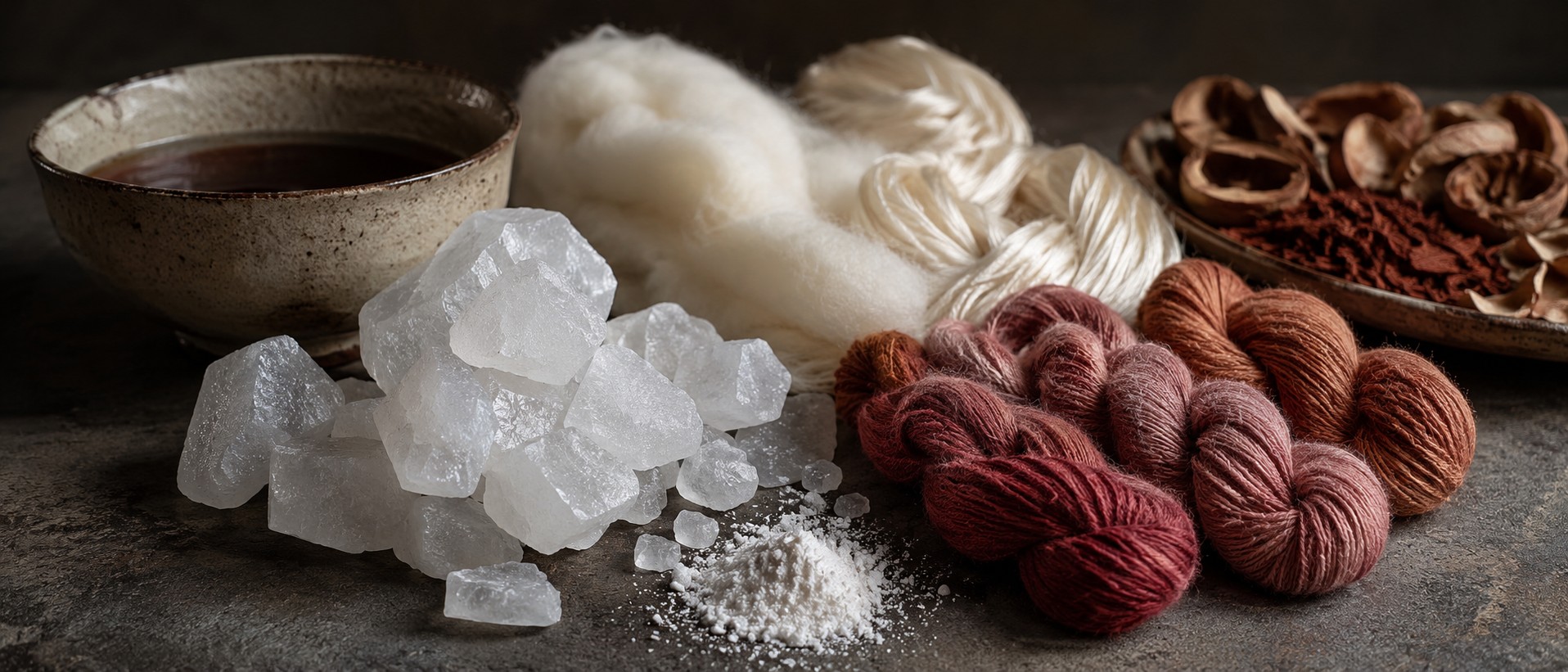
Behind the name lies potassium aluminum sulfate, chemically KAl(SO₄)₂·12H₂O. A water-soluble double salt from the group of sulfates. It occurs in nature as a mineral and is also produced synthetically.
Alum forms colorless, translucent crystals or appears as a granular powder. It is odorless, the melting point is 95.5 °C, and solutions of it react slightly acidic. A detail that becomes important for the dyeing process: solubility increases strongly with temperature. At 20 °C around 6 grams dissolve in 100 grams of water, at 80 °C it is already about 72 grams.
The purpose is clearly defined. For dyes to adhere permanently to the fabric, the fiber must be mordanted before the actual dyeing. The aluminum ions bind to the protein structure of animal fibers and form stable anchor points at which the dye molecules attach. This is why alum is particularly suited to protein fibers such as wool and silk. With cellulose fibers, other approaches are needed, such as a pre-treatment with tannins.
Alum color nuances: why the same madder root produces red one time and orange-red another
The fascinating thing about it: the same plant dye produces quite different shades with different mordants. The mordant is therefore not only a fixative but also a color regulator.
With alum as mordant, wool is dyed primarily red; madder produces a blue- to yellow-tinged red. On flavonoids, alum mostly yields yellow tones. A clear example comes from a madder dyeing experiment: alum produced a distinct orange-red, while iron sulfate on the same dye produced an equally distinct dark gray.
For comparison, the other mordants:
- Alum (aluminum salt): rather red nuances, with madder an orange-red, on other plants yellow tones
- Iron mordant: violet to brown, partly blackish tones
- Copper mordant: yellow-olive, green-olive, or brown
- Tin mordant: strong yellow or orange, shifts the red nuance toward the vibrant
Mordanted fibers also absorb the dye more deeply. The colors appear clearer and richer. This is one of the reasons why a naturally dyed wool rug often has a certain depth that is rarely seen with purely synthetic dyeing.
Washfastness and lightfastness: what the mordant does for the color over decades
Let us get to the core of the value proposition. Wool mordanted with alum and dyed with madder is characterized by high lightfastness and wash resistance. This is exactly the effect you are paying for when you buy.
Historically, this was the key technique: wool was pre-treated with alum so that the color did not simply fade after the first wash. The stable anchor points formed by the aluminum ion hold the dye firmly to the fiber. This is why alum-mordanted colors do not simply wash out.
It is not absolute indestructibility, however. Direct, prolonged exposure to sunlight should be avoided, otherwise even genuine natural dyes will bleach out over time. But compared to weakly dyed, unmordanted fibers, an alum-mordanted rug operates at a different level of durability.
Is alum really non-toxic? The sources explained clearly
This question is asked above all by families and allergy sufferers, especially when it comes to a rug for the children's room. A clear statement upfront: the sources are not entirely consistent, and that needs to be acknowledged.
The majority of specialist dyeing portals describe alum as one of the least toxic and least harmful mordants. For humans it is considered non-toxic. There is, however, one important note: for amphibians alum is lethal, which is why residual mordant bath must never enter the natural environment. And one German-language source contradicts this assessment, listing the salt as toxic today and advising against its use when working with children. Some guides also recommend keeping alum away from small children and pets during storage.
For context: as food additive E 522, alum is only very limitedly approved in the EU, for egg white and for glazed or candied fruit and vegetables. In Switzerland this is regulated by the Additives Ordinance (ZuV), in the EU by Regulation (EC) No. 1333/2008. The health assessment of aluminum compounds in Germany is handled by the Federal Institute for Risk Assessment (BfR).
Important for understanding: the much-discussed aluminum in deodorants is a chemically different compound from the potassium alum used in dyeing. Studies on cosmetics therefore cannot simply be transferred to textile mordanting. For you with the finished rug, what matters is: the mordant is firmly bound to the fiber, it is part of the hardened color system and does not exist as a loose powder in the pile.
Price and value retention: what the elaborate mordanting costs and delivers
Imagine a family in Bern comparing two rugs. A synthetically dyed runner and an alum-mordanted wool rug. The price difference is noticeable, and the question arises: why does one cost so much more?
The effort lies in the process. Natural dyeing with mordant is handwork across several steps. A look at the practice shows why: for 100 grams of wool, around 17 grams of alum are typically used, with 10 to 17 percent of the fiber weight being common depending on the recipe. Wool is heated to approximately 85 to 95 °C during this process, while silk is heated to only around 70 °C, because the fibers can otherwise disintegrate. The fibers are often left in the mordant bath overnight so that the mordant penetrates well. Only after that does the actual dyeing take place.
This effort is the reason for the higher price. Set against it is the lifespan. When the Bern family calculates the price premium against the years during which the colors remain stable thanks to wash- and lightfastness, the calculation often looks different from the first glance at the price tag. A hand-knotted wool rug is a long-term investment, and the mordant is part of what keeps it beautiful for so long.
How a naturally dyed rug stays beautiful in a Swiss home
Take the classic case: a wool rug in front of a large south-facing window in an attic apartment. The question about fading is legitimate. Even colorfast natural dyes do not appreciate prolonged, direct sunlight. Sun protection or occasionally rotating the rug helps keep the color even.
For cleaning, alum-dyed rugs follow essentially the same rules as other high-quality wool rugs, only with a little extra care. Hand-knotted oriental rugs are color-sensitive; this applies especially to plant-dyed pieces. Key points:
- Avoid direct, prolonged sunlight to prevent fading
- Refrain from beating the rug; beating is considered a faulty practice that can cause serious damage
- Approximately every four years a professional cleaning; this is a widely shared rule of thumb for hand-knotted rugs
In short: the rug requires no special treatment, but a little care and attention. Then the color that alum has anchored so permanently to the fiber will remain vibrant for many years.
FAQ
Does alum dyeing justify the higher price of a wool rug?
In many cases yes, if you think long-term. The mordant ensures high wash- and lightfastness, and the colors remain stable over years. The higher price comes from the elaborate hand process: the fibers are mordanted, often left overnight in the mordant bath, and only then dyed. Calculated against the lifespan of a hand-knotted rug, the price premium puts itself in perspective.
What colors result from alum compared to iron or tin mordant?
Alum: rather red nuances, with madder a distinct orange-red, on other plants yellow tones Iron mordant: violet to brown, partly blackish tones, on the same madder dye a dark gray Tin mordant: strong yellow or orange, shifts red toward the vibrant Copper mordant: olive and brown tones The same plant dye therefore produces a different shade depending on the mordant.
Is alum mordant for rugs really non-toxic?
Most specialist dyeing sources list alum as one of the least toxic mordants and as non-toxic for humans. One source contradicts this and classifies it as toxic, which is why we phrase this carefully here. What is certain: for amphibians alum is lethal, and residual mordant bath must not enter the natural environment. The aluminum in deodorants is chemically a different compound from the potassium alum used in dyeing.
Do alum-dyed colors remain stable over decades?
Largely yes. Wool mordanted with alum and plant-dyed is characterized by high lightfastness and wash resistance; this is historically documented. There is one qualification: prolonged, direct sunlight will cause even genuine natural dyes to bleach out over time. With sun protection and occasional rotation, the color stays vibrant for a long time.
Does an alum-dyed rug need to be cleaned differently?
It requires a little care and attention. Plant-dyed, hand-knotted rugs are color-sensitive. Avoid beating the rug, refrain from prolonged direct sunlight, and plan for a professional cleaning approximately every four years. Thanks to the firm color bond created by the mordant, a fundamentally different cleaning approach is not necessary.