Abrash Meaning: the Color Stripe in Hand-Knotted Rugs
The color stripe in the field: what you are actually seeing
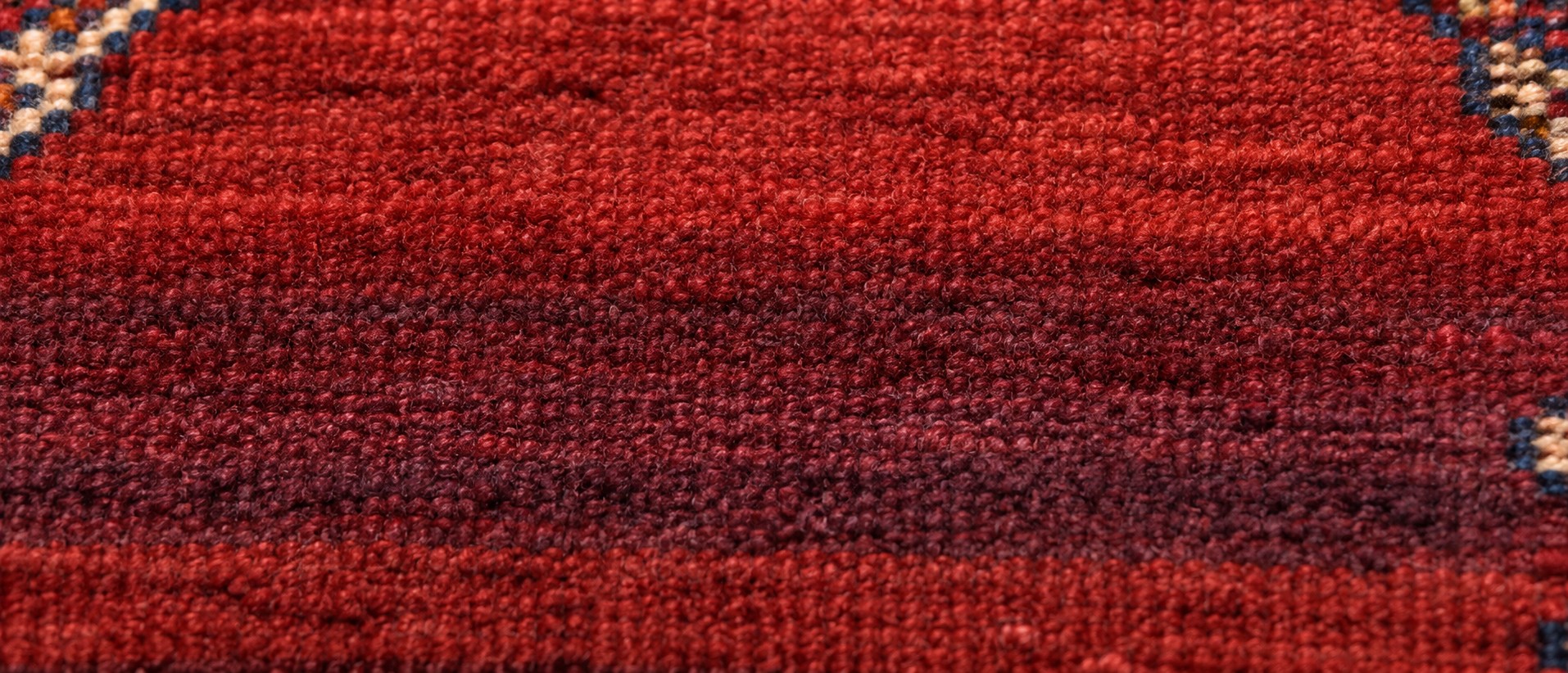
You are standing in front of a rug, the field is calm and uniform in color, and then a lighter or darker stripe runs across the surface. The first thought: a flaw. Faded, perhaps an error in the dyeing. With a hand-knotted oriental rug, the opposite is often closer to the truth. This stripe has a name, and it tells you something about the origin of the piece.
The technical term for it is abrash, also written as abrasch in many German-language sources. In English it is also called a color jump. Anyone who buys classic rugs will encounter it sooner or later, because with natural dyeing it is almost always present.
Abrash meaning: the color variation caused by yarn and dye lot
The abrash meaning can be defined clearly in technical terms: abrash is a visible color variation in the pile that occurs when the knotting switches from one batch of yarn to a new one. This new batch comes from a separate dye lot, and even with the most careful work, no lot turns out exactly the same.
The word itself already points in this direction. In Turkish, abraş means something like piebald or speckled; in Arabic, abrash means spotted. Others trace it through Persian to a word for dyeing. The precise etymology varies depending on the source, but the core idea remains: dappled, shaded, mottled.
Why do the lots differ? The causes are numerous: different temperature of the dye bath, varying consistency of the dye, different cooking times, sun drying, different mordants, the residual fat content of the wool, as well as the mineral content and pH value of the water. The natural color of the wool also plays a role, ranging from beige to brown to black, because each wool tone absorbs color differently.
Important for the visual effect: genuine abrash always runs perpendicular to the length of the rug. It can appear as a broad band, a stripe, or in isolated patches, sometimes barely visible, sometimes as a pronounced gradient-like transition across the entire field. With chemically dyed yarns it is significantly rarer, because industrial pigment control works more precisely. With natural dyeing using madder, indigo, or walnut, it is almost always present.
How genuine abrash looks, and where artificial abrash falls short
Because abrash carries positive associations, it is occasionally produced artificially. With machine-made goods, the effect is sometimes worked in deliberately to simulate an authentic appearance. Some manufacturers of high-quality machine-made rugs go to considerable lengths to achieve this. Two characteristics help you identify genuine abrash.
The direction of the stripes. Genuine abrash runs horizontally, parallel to the knotting direction, and follows the height of the rows of knots. If the stripes run diagonally or irregularly in all directions, caution is warranted.
The consistency across the entire piece. Genuine abrash appears in multiple fields and borders, because the yarn batches were changed for different parts of the rug. Artificially applied abrash is often visible in only one single area.
A note on natural color itself: indigo blue and madder red can today be imitated chemically with such precision that the color authenticity of a Persian rug is not always easy to verify. A reliable proof requires elaborate chemical testing, which a layman's eye alone cannot achieve.
The back-side test: the rug does not lie from behind
The most reliable check is the simplest one: turn the rug over. With genuine hand-knotting, the pattern on the back is just as clearly recognizable as on the front, and the abrash also shows on the reverse as a dyeing difference. The color is in the yarn itself, all the way through.
With artificial treatment, the color often only reaches the tip of the pile. The back of the knots then remains uniform, even though a stripe is visible on the front. And with purely machine-woven goods, the back looks blurred in any case, with a coarse grid or an applied backing coating. Anyone who carries out the back-side test answers two questions at once: hand-knotted yes or no, and abrash genuine or applied.
Nomadic versus workshop: when abrash speaks for a piece and when against it
Whether abrash is a plus point depends on the type of rug. With nomadic and village rugs it is practically part of the picture and is, depending on the standpoint, accepted or even desired. The wool here is usually dyed by hand in small batches, which makes abrash particularly common.
A Qashqai from a tribal loom is the classic example: several family members work at one loom, the yarn batches are self-dyed, and the color jump arises entirely on its own. Workshop rugs from smaller Iranian knotting centers such as Sirjan or Heriz also regularly show abrash, because natural dyeing and local dye works are used.
The situation is different with the finest workshop rugs. A Seyrafian Isfahan often remains almost abrash-free, because the workshop controls the dyeing closely and works with large, precisely coordinated lots and long yarn batches. Here the rule applies: with a very fine workshop piece, clearly visible abrash can rather indicate less careful workmanship. The same effect therefore reads completely differently depending on the origin.
And then there is the new commercial ware from Pakistan or India. It rarely shows genuine abrash, because industrial yarns are used. If a stripe appears there, it is usually deliberately incorporated as a sales argument.
Natural dye, patina, and why the effect becomes more beautiful with the years
With oriental rugs made with natural dyes, something beautiful happens over time: plant-based colors develop a special patina. Madder red and indigo, which already vary in concentration from lot to lot during dyeing, continue to mature over the decades and give the piece depth.
Abrash works alongside this process. A completely uniform surface looks flat and industrial. The fine stripes and transitions bring a lively interplay of light and shadow in the colors into the field, giving the rug character. According to the unanimous opinion of experts, abrash rarely diminishes the value of a hand-knotted piece to any significant degree; on the contrary, it can even enhance aesthetics and authenticity. As a sign of natural dyeing and pure handcraft, it is an argument in favor of the piece, not a reason to leave it behind.
FAQ
Is abrash a flaw or a quality feature?
With hand-knotted nomadic and village rugs, abrash is a recognized quality feature, not a flaw. It indicates that natural dyeing and pure handcraft were used, because the individual dye lots never turn out identical. Only with the finest workshop rugs, which are closely controlled in their dyeing, can pronounced abrash indicate less careful workmanship.
How do I tell whether abrash is genuine or artificially produced?
Pay attention to the direction and consistency. Genuine abrash runs horizontally, parallel to the knotting direction, and appears in multiple fields and borders of the rug. Diagonal or irregular stripes that occur in only one single area are suspicious. The surest check is a look at the back of the rug.
Does abrash diminish the value of a rug?
With hand-knotted pieces, generally not. According to the unanimous opinion of experts, abrash rarely diminishes value to any significant degree and can even enhance aesthetics and authenticity. It is regarded as proof of natural dyeing and handcraft. An exception applies to the finest workshop rugs, where pronounced abrash is rather read as an indication of less careful work.
Why is my Isfahan almost free of abrash, but my Qashqai full of it?
Because the production process differs. A Seyrafian Isfahan comes from a workshop that controls the dyeing closely and works with large, coordinated lots and long yarn batches, so it remains almost abrash-free. A Qashqai is made at a tribal loom where several family members knot with self-dyed yarn batches from small lots, which is why the abrash is so pronounced.
Does genuine abrash also show on the back of the rug?
Yes. With genuine hand-knotting, the color is in the yarn itself, so the abrash is visible from the back as a dyeing difference, just like the pattern. With artificial treatment, the color often only reaches the tip of the pile, and the back of the knots then remains uniform. The back-side test simultaneously clarifies whether the rug is hand-knotted at all.